-
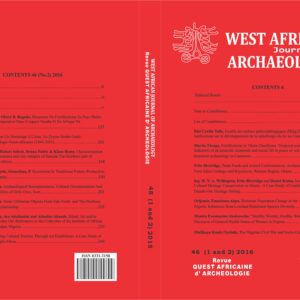
AA- Table of Content 38 & 39|Articles
Table of Content 38 & 39
1 ————————————————– 24 Pottery Traditions of the Earthworks of Southern Ghana: Test
Excavation at the Site of Ngyeduam
J. Boachie-Ansah Department of Archaeology and Heritage Studies University of Ghana, Legon, Accra, Ghana25 ——————————————– 41 Challenges of Dating and Sequencing in West African Stone Age Archaeology Since the 1970s
Obarè B. Bagodo Departement d‟histoire et d‟archéologie Université d‟Abomey-Calavi, Bénin Republic42 ——————————————- 50 Interpreting Benin Art Objects In Catalogues and Books as
Indigenous Photographs Captured in Conventional Photography
Kokunre Agbontaen-Ekghofona
Department of Sociology and Anthropology University of Benin Benin City51 ——————————————— 57 Archaeological Survey of Nri
A.I. Okpoko, A. M. Ibeanu, C.E. Umeokafor
Department of Archaeology and Tourism University of Nigeria, Nsukka.58 —————————————– 73 Rethinking The Archaeology of Zaria Area: Evidence From Recent Archaeological Investigations
Dr K. T. Odofin Department of Archaeology, Ahmadubello University, Zaria74 —————————————- 88 Iron Working Traditions in Idomaland and Northern Igboland
Border Communities
Ibeanu, A.M. and Inalegwu, S.A -
Archaeological Survey of Nri
$10.00A.I. Okpoko, A. M. Ibeanu, C.E. Umeokafor
Department of Archaeology and Tourism
University of Nigeria, Nsukka.Introduction
This study was borne out of the need to carry out archaeological surveys and excavations of
Nri settlement sites. Some of these sites were located by Onwuejeogu and later studied by
Okpoko (1988). It is important to observe that since the publication of the Igboukwu
excavation report by Shaw(1970) and consequent interpretation of the material remains by
Onwuejeogwu which he linked to the institution of Eze Nri; there has not been any
archaeological excavation in Igboukwu or related areas like Nri settlements. Following the
evidence of scatters broken quartz pebbles in Lake city secondary school at Nri a team of
archaeologists, comprising late Dr. F.N. Anozie; Professor A.I. Okpoko, Dr. A.M Ibe
anu conducted archaeological reconnaissance and excavation in the school compound.
However, further archaeological survey was carried out by Umeokafor (2006) in both Nri and
Igboukwu to throw some light on possible relationship between the two settlements.
Nri has been defined by Afigbo (1981) as a holy city where slaves were set free and
where also, the Osu caste system prevalent in many parts of Igboland is non-existent. Prior to
December, 1940, the town of Nri had two distinct and independent settlements namely, the
Akamkpisi and Agukwu communities. The Eze Nri resides in Agukwu made up of the
immigrants while much of the authonthons group the (first settlers) resided in Akamkpisi.
The two communities were unified under one administrative head on the above named date as
Nri town.
Late Dr. J.N Ezike and final year students of the Department of Archaeology University
of Nigeria, Nsukka conducted ethnographic and archaeological surveys of Nri and sunk a test
excavation in 2001.
In the period of the slave trade, Umu nri (Nri indigenes) adorned themselves with
wristlets, anklets and rubbed white chalk nzu on the eyelids. These identified them as umunri
that should not be kidnapped and sold into slavery by the Aro slave merchants (Anozie,
1983). This is because Nri men were seen as powerful ritualists. This paper is preliminary. -
Challenges of Dating and Sequencing in West African Stone Age Archaeology Since the 1970s
$10.00Obarè B. Bagodo
Departement d‟histoire et d‟archéologie
Université d‟Abomey-Calavi,
Bénin RepublicIntroduction
The dating and sequencing of the human past started before, and continued with the inception
and the development of archaeology as a scientific discipline. This standpoint is important for
a fuller understanding of the dating and sequencing issues in the World Stone Age
Archaeology. It is also important for putting into perspective the use of radiometric dating
techniques as from the 1950s onwards with particular reference to West Africa. The
retrospective and prospective consideration of the West African case study since the 1970s is
emphasised.
After a long period of worldwide antiquarianism till the 19th century, the continuing
quest for dating and sequencing of human past led the Danish archaeologist Christian J.
Thomsen to propose in 1836 a-three-system of Stone, Bronze and Iron Ages. The same
motivation led the French antiquarian and archaeologist Jacques Boucher de Perthes to
undertake excavations at Abbeville, France, from 1837 to 1847. His publications between
1847 and 1860 established the first evidence associating human artefacts and bones of extinct
animals. In the same vein his “Celtic” and “Antediluvian” Antiquities anticipated the terms
“prehistory”, “palaeolithic” and “neolithic” asproposed by the English naturalist Sir John
Lubbock in 1865. In addition, from 1859 to 1871, the English naturalist Charles Darwin
established the evolutionary origin and development of plants, animals, and humans.
In the first half of the 20th century, new field techniques and global relative chronology
were achieved through: (i) the grid-square method pioneered by the English archaeologist Sir
Mortimer Wheeler; (ii) the criteria for chronological ranking of sites‟ evidence and the
problem-oriented stratigraphic excavation initiated by the American archaeologist Alfred
Kidder; and (iii) the pioneering use of pollen analysis in 1949-51 and the framing of five
evolutionary modes of Stone Age technology in 1969 by the English archaeologist Grahame
Clark. During the first half the 20th century, the South African archaeologist A.J.H. Goodwin
proposed in 1925 an African-centred two-stage subdivision of Earlier and Later Stone Age,
and in 1927 he suggested the term „Middle Stone Age‟. Finally in 1929 he co-authored with
C. Van Riet Lowe a synthesis titled The Stone Age cultures of South Africa.
From the second half of the 20th century and onwards, the breakthrough came with the
advent of the Radiocarbon (i.e. C14) dating technique between 1947 and 1949, followed by
the subsequent development of other radiometric/isotopic dating methods in the 1960s and
1970s. The Radiocarbon and other isotopic dating techniques have all revolutionized the
„absolute‟ dating and sequencing in the Stone Age Archaeology.
Such advances in the worldwide vision and technical skills of dating and sequencing of
Stone Age cultures have notably impacted the whole of Africa since 1947 with the Nairobihosted
1st Pan-African Congress for Prehistory and Quaternary Studies, and especially West
Africa since 1969 with the Ibadan-hosted Interdisciplinary Symposium on the role of
stratigraphy in geology and archaeology.
As a result, the retrospective and prospective emphasis of the African continental
picture as a whole with particular emphasis on the West African situation is herein taken into
account. The African picture is handled as a by-product of the world background challenges
and achievements in the dating and sequencing issues in the Stone Age Archaeology. -
Interpreting Benin Art Objects In Catalogues and Books as Indigenous Photographs Captured in Conventional Photography
$10.00Kokunre Agbontaen-Ekghofona
Department of Sociology and Anthropology
University of Benin
Benin CityAbstract
A number of Benin (Nigeria) art objects, particularly brass plaques have been recognized as
serving the purpose of mnemonics, to aid the recalling of events or persons represented in the
art work. After the dispersal of the Benin art works in1897, these art works were
photographed and documented in catalogues and books and found their way to various
museums worldwide. Catalogues and books such as Read and Dalton‟s Antiquities from the
City of Benin and Other Parts of West Africa in the British Museum (1899), Ling Roth‟s
“Personal Ornaments from Benin” (1899) Felix von-Luschan‟s Die Karl Knorr „sche
Sammlung von Benin-Alterumrn in Museum for Volkerkunde in Stutttgart, (1901) and Die
Altetumer von Benin” (1919) adequately presented several of these objects in photographs.
For numerous people, including Benin indigenes without actual physical contact with these
objects in museums and private collections, photographs serve as the only means of viewing
the objects. Using qualitative methods, this paper re-examines a photograph and the original
caption in light of the indigenous interpretation from ethnographic research and oral literature
in Benin City. How the photograph assists our understanding of Benin culture is highlighted.
Barthes‟ methods of structural analysis in photographic message is used, as a selected
photograph of brass plaque is examined and reinterpreted afresh from information gathered
from field interview in Benin City, Nigeria. -
Iron Working Traditions in Idomaland and Northern Igboland Border Communities
$10.00Ibeanu, A.M. and Inalegwu, S.A.
Introduction
Technology is defined as a methodical utilization of natural resources and forces based on of
the knowledge of nature in order to take care of man‟s need. (Brugger 1974 in Nwoko 1992)
However, others see technology as any application of the discoveries of science or the
scientific method to the problems of man and his environment in peace and war (Berry 1983
in Nwoko 1992). The identification and exploitation of mineral resources in a given
environment is seen as man‟s attempt to adapt and survive. As a result, it is a constructive
engagement which man must of necessity make with his environment (Ibeanu and Okonkwo
forthcoming). For example, it was the need for more efficient tools for hunting, and
agriculture that led to improved techniques and sourcing of quality stone raw materials and
the smelting of iron ores. However, the increased exploitation of quality iron ores for iron
smelting further expanded human group interaction with one another, urban societies and
trade.
This study is geared towards the documentation of iron working traditions of parts of
Idomaland in Benue state and adjourning northern Igbo communities, such as, Abakaliki and
Nsukka. This will enable us to trace possible relationships or similarities in their iron working
traditions in time perspectives. Many archaeological studies had been carried out in Nsukka
area in terms of excavation and dating of iron working sites (Anozie 1979; Okafor 1993;
1995). Most iron smelting sites in Nsukka and Nwofe in Abakaliki seem quite old and
thepresent inhabitants of such sites as Opi and Lejja are ignorant of the archaeological
data/smelting traditions unlike the Umundu and Nrobo where knowledgeable elders and
blacksmiths who either observed/participated as children in iron smelting. They still
remember the processes of iron working comparable to their Idoma neighbours in such places
as Otukpo, Otukpa, Igede and Utonkon where extensive iron smelting took place. In these
places there is demonstrable link between the present inhabitants and archaeological data. For
example, one can still observe dilapidating smelting furnaces in farmlands and some elders
were able to identify smelting and smithing slags. It is a common in most farmlands in
Otukpa to see pieces of slag, broken furnace walls and potsherds littered around as part of the
landscape. It is important to note, that human activities due mainly to population pressure is
adversely affecting these finite archaeological resource that would enhance our outstanding
and interpretation of ancient iron smelting traditions.
It is pertinent to point out that much work has been done in Nsukka, as against parts of
Benue where no archaeological excavation or dates have been obtained from Idoma iron
smelting Sites. However, on the basis of furnace types, only the shaft furnace has so far been
identified. This is seen to be the most recent furnance type which gave a more efficient smelt
compared with older furnace types observed in Nsukka and Abakaliki areas.
It has been observed by Nwoko (1992 that no society can make any headway in
technological advancement without a systematic and critical appraisal of the reality around
her and assuming the society wants to borrow by way of technological transfer, members of
such society must develop their required attitude as well as critical mind about life for the
borrowed technology to contribute to their welfare. -
Pottery Traditions of the Earthworks of Southern Ghana: Test Excavation at the Site of Ngyeduam
$10.00J. Boachie-Ansah
Department of Archaeology and Heritage Studies
University of Ghana, Legon, Accra, GhanaAbstract
Test excavation conducted 100 m away from an earthwork near Ngyeduam in the Central
Region of Ghana has produced pottery, a grindstone, ironslag, a corroded iron object, nuts of
Elaeis guineensis, bones of undomesticated animals and shells of Achatina achatina. It is not
known whether the pottery from the excavation is related to the construction of the earthwork
since no excavations were conducted in the earthwork. Five radio-carbon dates obtained for
the site suggest that it was occupied from the first half of the fifteenth century to the early
seventeenth century. Claims have been made that there is discontinuity between the pottery
associated with the earthworks of southern Ghana and a later Akan pottery which succeeded
the pottery associated with the earthworks in several sites of southern Ghana. This has often
been interpreted as evidence of a significant break in the cultural and/or demographic
continuity in the history of the southern forest area of Ghana, and that the earthworks of the
forest region of southern Ghana were not built by the Akan. Although it is not known
whether the pottery is associated with the earthwork, the pottery exhibits some characteristics
of the pottery found on earthworks sites known in the literature as the Earthworks Pottery and
Akan pottery. This ceramic evidence, as well as evidence from other sites, suggest continuity
between the pottery associated with the earthworks of southern Ghana and the pottery of the
Akan, whose ancestors, more than any other group, were probably the builders of the
earthworks. -
Rethinking The Archaeology of Zaria Area: Evidence From Recent Archaeological Investigations
$10.00Dr K. T. Odofin
Department of Archaeology,
Ahmadubello University, ZariaIntroduction
The state of archaeological investigation in the Zaria area can still be explained to be
exploratory. This can be seen in terms of limited reconnaissance and excavations of sites,
little application of analytical scientific techniques to archaeological investigations and
patchy and unrepresentative dating of material evidence.
In terms of frequency of studies of archaeological sites in the Zaria area (fig. 1) between
1970 and 1980, the iron smelting site of Samaru West appears to have attracted more
attention by pioneering researchers (Obayemi 1976 and Sutton 1976) more than others
(Effah-Gyamfi1981a). The close proximity of Samaru West site to the main campus of the
Ahmadu Bello University Zaria, Nigeria seemed to have been responsible for this. Samaru
West site was first excavated by Obayemi and dated to the 7th century AD (Sutton 1976) and
subsequently by Sutton (1976) who also excavated the site and obtained 8 Radio Carbon
dates within the range of 7th and 8th centuries AD, which seems to lay credence to Obayemi‟s
earlier date. Subsequent investigation conducted by Effah-Gyamfi (1981a) did not however
involve any dating. A subsequent archaeological study of the same site conducted by Dilli
(1986) was essentially reconnaissance in nature and merely aimed at documenting the
material evidence of iron smelting which was then under serious threats of erosion.
The Tsauni North iron smelting site was located in 1975 by Sutton through Dr J.H
Polhemus who reported it to Sutton (Sutton 1985). Material evidence of iron smelting was
discovered at Tsauni north in association with terracotta figurines (Sutton 1985). The
figurines at Tsauni North are made of coarse textured clay, characteristically small and with
distinct artistic features which Sutton considered not to belong to the Nok style (Sutton
1985).
Sutton‟s archaeological research on iron smelting in Samaru West and Tsauni was
essentially a study of the technical basis of iron smelting there. Specifically, the study of the
typology of iron smelting furnaces and tuyeres appeared to have mostly engaged his
attention. In the study, Sutton observed that Tsauni north furnaces which he categorized as
Taruga style are associated with „standard‟ tuyeres (Effah-Gyamfi 1981b; Sutton 1985),
while Tsauni South furnaces which belong to the Samaru West type are associated with
„massive‟ tuyeres (Sutton 1985). He further considered the Tsauni north furnaces to be
contemporaneous with Taruga and the Nok culture (Sutton 1985), while the Tsauni south and
Samaru West ones are dated to the second half of the first millennium AD (Sutton 1985)
about a thousand years later than the Taruga style. The dates given by Sutton for the furnaces
of Tsauni north and south were essentially speculative as they were based on the
extrapolation of information from the C14 dates from the sites of Taruga, Samaru West and
Dalla Hills rather than any scientific dating.