-
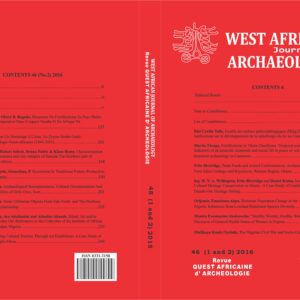
AA Table of Contents 48
Table of Contents
Adande, Alexis: We, African Archaeologists, Who Do We Serve? ………………..1
Ogundiran¹ Akinwumi, Macham Mangut², and Olusegun Moyib³:
The Archaeological Landscape of Bara, near Oyo-Ile…………………..……….15
Holl, F. C. Augustin : Exercise, Violence, Illness, and Death: Mortuary Programs as Curriculum-Vitae …………………………………………………….33
Ogundele, S. Oluwole : Nigeria’s Place in the Sun: Colonial/Neo-colonial
Agendas, Contested Narratives and Post-Andah Archaeology ………..….45
Tubi, Fr. Paul-Kolade : Ethnoarchaeological Importance of Lokoja Rockshelters.
………………………………………………………………………………..…..57
John Kelechi Ugwuanyi: Hegemonic Heritage and Public Exclusion in Nigeria:
A Search for Inclusive and Sustainable Alternatives ………………………………..71
Fr. Paul-Kolade Tubi,:Field Archaeology in Israel: A Short Note. ……………109
José Farrujia de la Rosa: The Amazigh people of Western Africa: the early colonization of the Canary Islands. …………………………………………….121
N´zi Dibié Charles: Vers une nouvelle configuration de l’archéologie en Côte d’Ivoire ? ……………………………………………………………………….131
-
Ethnoarchaeological Importance of Lokoja Rockshelters
$10.00Ethnoarchaeological Importance of Lokoja Rockshelters
By
Fr. Paul-Kolade Tubi, PhD
Department of History and International Studies
Federal University Lokoja, Kogi State, Nigeria
08035984669
Abstract
Rockshelters are durable archaeological niches. This paper aims to examine the importance of rockshelters in Lokoja. The methodological approach is ethnoarchaeology, which has the capacity to integrate archaeological data with ethnographic data in a single study. Data indicate that Lokoja has many rockshelters, crevices and subterranean hills. Findings from the research show that these hills have been of valuable use to human beings since antiquity. In conclusion, the study relying on ethnographic inferences argues for the relevance of rockshelters in the study of Lokoja. The sites are recommended for archaeological excavations so as to deepen our knowledge of human occupation and activities in Lokoja area from antiquity.
Key words: Rockshelters, Ethnoarchaeology, Lokoja
-
Exercise, Violence, Illness, and Death: Mortuary Programs as Curriculum-Vitae
$10.00Exercise, Violence, Illness, and Death:
Mortuary Programs as Curriculum-Vitae
Augustin F.C. Holl
Department of Anthropology
Xiamen University, Fujian, China
Introduction
More than sophisticated studies of material culture remains, mortuary evidence provides access to profound insights into past and present communities lives and values (Chapman et al 1981, Di Lernia and Manzi 2002, Di Lernia and Tafuri 2013, Holl 2013, Holl and Bocoum 2006, 2014, Holl et al 2007, Metcalf and Huntington 1991, Tafuri et al 2006). As paradoxical as this may appear at first glance, burial is much more an issue for the living members of the communities than for the deceased individuals. It is the living members performing the funerals and burial processes who make decisions about which ones of the many aspects of the deceased individuals’ life to transfer in the grave.
As far as Africa is concerned, the cognitive break-through that resulted in the “institutionalization” of burials took place during the later part of the Late Pleistocene. Isolated human burials are found in different sites in North Africa, the Nile Valley, and West Africa. They range in date from 50000 to 9000 BP and are documented at Taramsa I, Shum Laka, Mbi-Crater, Wadi Kubbaniya, Amekni, Ti-n-Hanakaten, Iwo Eleru, to mention the most important finds (Figure 1). Formal disposal areas – cemeteries – emerged during the later part of the Iberomaurusian period in North Africa, at such sites as Mechta el Arbi, Afalou Bou Rhummel, Columnata, Beni Saf, Taforalt, and in Nubia at Jebel Sahaba (Balout 1955a, b, Wendorf and Schild 1986, Wendorf 1968, Willoughby 2007). From that period on, and in varying degrees according to time and places, burial practices in isolated graves and cemeteries became integral part of the human cultural package. It goes without saying, but worth emphasizing nonetheless, at this juncture of that: burials and cemeteries are more than simple spots in the landscape. They are manifestations of the operation of social practices and institutions that connect both worlds: that of the living and that of the dead.
This paper sets out to explore and bring to light pieces of social singularities fossilized in the archaeological record at a number of sites located in the northern hemisphere of the continent (Holl 2013). The approach adopted is bio-archaeological, “the deduction of information about behaviour, life style, diet, and health out of skeletal remains” (Facchini 2008: 27, Larsen 1987). The sample is longitudinal and ranges from 21-19000 to 3000 BP It includes Late Pleistocene foragers burials from Waddi Kubbaniya and Jebel Sahaba in the Nile Valley, and Iwo Eleru in southwestern Nigeria, and Early and Late Holocene Shum Laka in West Africa. Each of the selected case study is unique and refers to specific circumstances, without any claim at cultural connection or continuity.
-
Field Archaeology in Israel: A Short Note
$10.00Field Archaeology in Israel: A Short Note
Fr. Paul-Kolade Tubi, PhD
Department of History and International Studies
Federal University Lokoja, Kogi State, Nigeria
08035984669
Introduction
The idea of participating in an archaeological field work in Israel was conceived as a result of the desire to carry out a comparative study of fieldworks in Nigeria and Israel. To achieve this, it became necessary to link up with a university in Israel which has a reputation for archaeological fieldworks and expertise and which session would accommodate the researcher’s academic calendar in Nigeria. The Zinman Institute of Archaeology of Haifa University, Israel met the criteria.
The Session 18 of the archaeological expedition to Hippos-Sussita commenced on September 1, and ended on September 15, 2017. In all, 40 archaeologists and aficionados participated in the dig. The whole site is under the supervision of the Zinman Institute of Archaeology and the researcher was the only African in the team.
-
Hegemonic Heritage and Public Exclusion in Nigeria: A Search for Inclusive and Sustainable Alternatives
$10.00Hegemonic Heritage and Public Exclusion in Nigeria: A Search for Inclusive and Sustainable Alternatives
John Kelechi Ugwuanyi
Department of Archaeology, University of York, [email protected]
Department of Archaeology and Tourism, University of Nigeria,
Abstract
The continued practice of ‘Authorized Heritage Discourse’ (AHD) in Nigeria and the non-impact it has on local communities calls to question the sustainability of heritage management in the country. The way archaeology, anthropology and other related disciplines that study and contribute to the management of heritage were introduced into the country made the entire heritage management processes non-inclusive and unsustainable. Established heritage institutions have for long existed as ivory towers with little or no impact on local communities. This paper examines the implications of this hegemony on the Nigerians’ heritage consciousness and further established how the current practices exclude the people that create and use heritage in their cultural places. The essay considered the recognition and integration of indigenous heritage knowledge systems and practices (focusing on the Igbo village arena (or ‘square’) with specific examples from Nsukka cultural area in southeast Nigeria) into the western model – AHD to boost public inclusion and encourage sustainability.
-
Nigeria’s Place in the Sun: Colonial/Neo-colonial Agendas, Contested Narratives and Post-Andah Archaeology
$10.00Oluwole OGUNDELE (Ph.D.),
Department of Archaeology and Anthropology,
University of Ibadan,
Ibadan, NIGERIA.
Email: [email protected]
Abstract
Archaeology started in Nigeria during the second half of the 20th century, primarily as a colonial enterprise aimed at justifying the evil of the unholy entanglements of the country with Europe. But the robust Nigerian archaeological record proved the European colonizers and their collaborators wrong. One good example in this connection, was the evidence of iron smelting technology and sophisticated artistic tradition of sculpting animal and human figures among other things in the Nok Valley region of central Nigeria. These advanced materialities coupled with socialities and/or ideologies have been dated to approximately between 500 B.C. and 250 A.D.
Contrary to the pre-conceived notions of the West, Nigeria down the ages was not unchanging. The above spectacular discoveries led to the application of evolutionary theories of history originally developed by such scholars as Darwin, Spencer, Morgan and Marx. According to the pioneer archaeologists in Nigeria and West Africa as a whole, the Western world with its industrial capitalism has been positioned by nature to conquer the lower civilizations, in order to liberate them from the bondage of underdevelopment. This underscores the reason why a conspicuous space was created for diffusionism including migrationism as a theoretical construct to explain the Nigerian archaeological record. This shows the duality of archaeology – a science and a socio-political engagement. It is not an innocent scholarship.
Given this situation, some African archaeologists especially Bassey Andah of Nigerian extraction, began as from the mid-1970s to develop a new set of paradigms to legitimately promote Africanisation which had hitherto been thoroughly undermined by the adherents of colonial anthropology/archaeology like Leo Frobenius and Friedrich Ratzel of the German Cultural-Historical School of Anthropology. Andah’s revisionist conception of the African scripts was anchored to indigenous Nigerian epistemologies, a basis for producing an authentic Nigerian/African knowledge. But much still remains to be done up to now in terms of moving forward. Encumbrances like a gross lack of research funds, political instability and dearth of ideological engagements or debates among indigenous archaeologists continue to weigh the system down. Consistent overseas financial supports and/or other forms of assistance for archaeological activities in Nigeria and Africa as a whole are not value-free. They are a subtle exercise in marginality and crisis. This scenario does not create room for mutuality of respect and sustainable cultural heritage management. Consequently, Nigeria remains a puppet of the Western intellectual oligarthy. The Euro-American academy majestically rules the African archaeological heritage landscape. Nigerian archaeologists need to wake up and reclaim their manifest destinies by showing greater initiative enshrined in robust, home-grown theoretical groundings critical to their becoming vibrant players in the competitive world of modern education.
-
The Amazigh people of Western Africa: the early colonization of the Canary Islands
$10.00The Amazigh people of Western Africa: the early colonization of the Canary Islands
José Farrujia de la Rosa
Sociedad Española de Historia de la Arqueología
History of Archaeology Research Network
Abstract
The Amazigh people from North Africa settled in the Canarian Archipelago at the beginnings of the 1st millennium BC and developed a culture on the islands that can be linked to native North African societies and magical-religious practices associated with the religions of the ancient Amazigh. Nevertheless, the research developed during the 19th and the beginnings of the 20th centuries underestimated the African roots of the Canarian past. This paper analyze the archaeological evidences that reinforce the African roots of the Canarian indigenous people, and the theoretical and political reasons that help to understand how the colonial past has played a crucial role in the making of the image of the Canarian natives.
Keywords
Prehistoric archaeology, Africa, Canary Islands, Amazigh, human colonization, colonialism, heritage.
-
The Archaeological Landscape of Bara, Near Oyo-Ile
$5,000.00The Archaeological Landscape of Bara, Near Oyo-Ile
Akinwumi Ogundiran¹, Macham Mangut², and Olusegun Moyib³
- The University of North Carolina at Charlotte, USA
- University of Jos, Nigeria
- University of Ibadan, Nigeria
Corresponding Author: [email protected]
Abstract
Located about 1.2 km northeast of Oyo-Ile is the site that is widely believed to have served as the burial ground for the kings of Oyo between ca. 1620 and 1837. Known as Bara, the site eluded the search of many archaeologists for many years, until now. We identified the site in 2017 with the help of local informants and have since begun its systematic archaeological survey. In this paper, we discuss the landscape approaches that we have used to understand the archaeological resources of Bara. Our study has revealed that the site was more than a burial ground for the deceased Oyo kings. It was also a thriving settlement of about 6.6 km in circumference with residential and farming components, among others. We also report the archaeological features that characterize the settlement, and provide the first comprehensive layout of the site. In addition, we address the fact that Bara is at the risk of losing its archaeological integrity due to the effects of farming and cattle herding activities. The current study offers immense promise for further studies. We propose that Bara holds an important key for understanding the political, social, and political economic processes that shaped the development of Oyo Empire. Further research promises to confirm this proposition.
-
The Transition in Grinding Stone Technology in Kabba, Kogi State Nigeria
$10.00The Transition in Grinding Stone Technology in Kabba, Kogi State Nigeria
1,2Uzuegbu Joshua Okenwa, and
2Ibeanu, Anselm Maduabuchi
1Humanities Unit, School of General Studies, University of Nigeria, Nsukka
2Department of Archaeology and Tourism, University of Nigeria, Nsukka
Corresponding Author: Uzuegbu, Joshua Okenwa Ph.D
Abstract:
Food processing is an integral aspect of humanity which helps to sustain and make food ready for consumption. This paper examines the transition and sustenance of food grinding technology of the early occupants of Kabba people to the present. Our research identifies the big and small grinding elliptical hollows-ako on top of Obangogo hill as the earliest grinding platform used by the people. This was followed by use of moveable grinding stones which were fashioned from the numerous rocks on the hill. The use of grinding stones continued even when the people moved down the hill to settle on the plain land. Presently, other grinding platforms are being used. The study is purely based on ethno archaeological approach.
Key words: Transition, Technology, Grinding stone, Elliptical hollow, Kabba
-
Vers une nouvelle configuration de l’archéologie en Côte d’Ivoire ?
$10.00Vers une nouvelle configuration de l’archéologie en Côte d’Ivoire ?
Dr N´ZI Dibié Charles,
Archéologue, Attaché de recherche
Institut d’Histoire, d`Art et d’Archéologie africains (IHAAA), Université Félix Houphouët-Boigny – Abidjan, Côte d’Ivoire
Résumé
En Côte d’Ivoire, les aménageurs économiques, contraints de plus en plus par la législationen vigueur, ont commencé à solliciter depuis les années 2010 l’intervention d’archéologues avant le début de leur chantier (Kouassi 2014 ; N’zi 2016) – afin de documenter les sites et le patrimoine culturel menacés de destruction. Cette intervention des archéologues se déroule dans le cadre des Etudes d’Impact Environnemental et Social (EIES). Le système definancement des EIES par les aménageurs (principe du « pollueur-payeur »), qui paye aussi le coût des opérations d’Etude d’Impact Archéologique (EIA), est désigné comme un système «capitaliste » par rapport à un modèle dit « socialiste », dans lequel les financements sont assurés par l’État (Kristiansen 2009 ; Van den Dries 2012). La combinaison de ces deux modèles de financement pourrait reconfigurer les recherches archéologiques en Côte d’
Ivoire.
Alors, à quoi ressemblera l’organisation et le fonctionnement de l’archéologie en Côte d’Ivoire dans les prochaines années
-
We, African Archaeologists, Who Do We Serve?
$10.00We, African Archaeologists, Who Do We Serve? by Alexis ADANDE Retired archaeologist and ordinary member of WAAA/AOAA First of all, I acknowledge with gratitude the opportunity given to me by the Executive Board of WAAA/AOAA and the local organizing Committee to be part of the trio of keynote speakers at the opening of the XV th colloquium of our Association. It is a great honour for me to take the floor after my Elder, Professor James ANQUANDAH, one of the founders of our Regional Association. I am giving a summary in English first and then develop in French my paper which is articulated as follows: The introduction which is setting the context of my initial question. As archaeologists we know how important it is to analyze each artefact or finding in its very context and how complex it may be. We also know that it is the same rule for the historians with the facts and the chronology.