

Best Seller Items


-
2019 Igbo-Ukwu Research Project
$10.00Short Notes on the 2019 Igbo-Ukwu Research Project
Kingsley Chinedu Daraojimba
Department of Archaeology and Tourism
University of Nigeria. Nsukka
[email protected]
Introduction
Igbo-Ukwu is a world renowned archaeological site which lies about 40 kilometres east of the
lower Niger River in Anambra State, Nigeria (Fig. 1). The Igbo-Ukwu Archaeological and
Heritage Project began its first phase in November 2019. The revisit to the site was the first
after six decades the original excavations were conducted by Professor Thurstan Shaw.
Between 1959 and 1964, Shaw’s excavations in the three sites (Igbo Richard, Igbo Isaiah and
Igbo Jonah) revealed a royal burial chamber and large collection of intricately decorated
pottery, bone and ivory, objects of copper, iron and elaborate bronze art, fabric, carnelian, stone
and coloured glass beads dated over 1000 years old (Shaw 1970; 1977). In response to poor
attention to the renowned Igbo-Ukwu sites, a community-engaged archaeology project was
conceptualised by Shaw’s widow, Pamela Jane Smith, in consultation with compound owners,
the Traditional Ruler and the Anozie family.
Community archaeology though far from new in Africa, where archaeologists such as Thurstan
Shaw and Merrick Posnansky have practised it (Schmidt 2014), many researchers still poorly
engage local and indigenous communities in their research approach (Pikirayi and Schmidt
2016). There are several hindrances responsible for this poor community-researcher
engagement. Some of such hindrances among others include mistrust arising from damaging
experiences under colonial rule, looting and sale of cultural items and non-obedience to the
culturally or socially prohibited rules guiding the preservation of cultural heritage (Aleru and
Adekola 2016). Community archaeology is archaeology of the people, for the people and by
the people. In other words, it is an archaeological activity that is focused on drawing a
connection between communities and archaeological remains for the purose of benefitting the
local community and preservation of their archaeological heritage (Lewis, 2018). Since
community archaeology was more about what the community needs and not what the
archaeologist thinks the community needs (Smith et al. 2020), this ten day inclusive community
approach was targeted at handing over, at least, partial control of the project to the local
community. This approach was targeted at promoting indigenous views in interpretations and
to empower communities to benefit from and participate in developing their ownarchaeological sites. The approach is important as the first phase of the efforts to launch a long-
term archaeological project in Igbo-Ukwu. This paper briefly describes the first phase of theproject and highlights the possibilities in the area for future archaeological research.
-
60 Years of Archaeological Research and Practice in Southeast Nigeria: An Appraisal
$10.0060 Years of Archaeological Research and Practice in Southeast Nigeria:
An Appraisal
By
Edwin E. Okafor
Department of Archaeology and Tourism
University of Nigeria Nsukka
Elochukwu A. Nwankwo
Department of Archaeology and Tourism
University of Nigeria Nsukka
And
John U. Ngonadi
Department of Archaeology and Tourism
University of Nigeria Nsukka
Abstract
The advent of archaeology in Southeast Nigeria can be traced to the famous Igbo-Ukwu excavations in 1961 by Professor Thurstan Shaw and his team. Since then, the discipline has unravelled many other archaeological sites in the region. This study was aimed at looking at the archaeological research in Southeast Nigeria since 1961 with a view to understand the various progress, contributions, challenges and prospect of the discipline in the region. So many archaeological researches have been conducted in the region since inception with remarkable contributions. The famous Igbo-Ukwu bronze pot dated to 9th BC, discovery of similar Acheulian tools at Ugwuelle, the discovery of the oldest iron working technology in West Africa in Lejja, among others. Archaeological research has contributed significantly to culture preservation and identity promotion of the region, and the consequential impact on the world archaeological map. Some challenges like poor funding, inadequate facilities, obsolete legislation, and poor public/community support, among others were identified as the challenges of archaeological research in Southeast Nigeria since inception in 1961. Practical recommendations like establishment of more archaeology departments in the region, institution of government special intervention scheme, public awareness and academic publications, support for regular students’ field school, systematic public/community orientation and involvement, among others, were recommended to consolidate archaeological research and practice in Southeast Nigeria. This study has implications for improved and sustainable archaeological research and practice in Southeast Nigeria.
Keywords: Archaeological research and practice, sites, museums; iron smelting; Excavations and reports.
-
A CONSIDERATION OF ETHICAL ISSUES IN ARCHAEOLOGY AND ANTHROPOLOGY
$10.00A CONSIDERATION OF ETHICAL ISSUES IN
ARCHAEOLOGY AND ANTHROPOLOGYBy
KOLA ADEKOLA
Department of Archaeology and AnthropologyUniversity of Ibadan
E mail: [email protected]Introduction
Archaeology is unique amongst all disciplines in that its data are non-
renewable. Once the archaeological data is destroyed, the informationthat can be derived from such data is lost.
As a result of this, professional bodies such as the Society for
American Archaeology (SAA); Archaeological Institute of America
(AIA); European Association of Archaeologists (EAA); Australian
Archaeological Association (AAA) and Society of Professional
Archaeologists (SOPA) which was founded in 1978 in America and
Archaeological Association of Nigeria have since their formation
concerned themselves with the need for a minimal level of expertise in
various areas of archaeological research. Not only this, the associations
aim at promulgating code of ethics for American, European and
Australian archaeologists. This function is a main concern of the World
Archaeological Congress at the global level. In many instances, the
tenets of the codes are applicable at all regions Nigeria inclusive.
In this paper, we are interested in examining amongst other things, the
professional responsibilities of archaeologists and anthropologists. -
A Contribution to Heritage and Islamic Archaeology of Bauchi Region, Northern Nigeria
$10.00A Contribution to Heritage and Islamic Archaeology of Bauchi Region, Northern Nigeria
Abubakar Sule Sani
Department of Archaeology
Ahmadu Bello University, Zaria
Email: [email protected]
Abstract
This paper attempts to appraise the influence of Islam and related thematic factors on socio-political developments in Bauchi region in the last 1500 years. It considered archaeological evidence from excavations of some sites from southern Bauchi area. Oral traditional sources were also used in the paper. Socio-political developments in the Bauchi region are highlighted by long distance trade, slave trade and other specialised processes of craft production. Islam would appear to have inspired the alteration of existing local political systems by the realignment of Islam into the mainstay socio-political structure of Kasar Bauchi; especially, in the early part of the 19th century after the Sokoto jihad ran by Uthman ibn Fodio. In addition, cultural developments in the region were also facilitated by population movements from Bornu, Kwararafa and other Hausa states. There is need for more studies by anthropologists and archaeologists interested in the influence of Islam on African societies in the last millennium. The work concludes that complementary use of sources such as archaeology and oral histories are vital to a better understanding of cultural developments in the region and beyond.
Keywords
Bauchi, jihad, oral traditions, archaeology, socio-political development
-
A Study of Ancient Subsistence Strategies of the Coastal Dangbe of Ghana: An Archaeological Perspective
$10.00Beveridge Fritz
Department of Archaeology and Heritage Studies
University of Ghana, Legon, Accra, Ghana.Abstract
Significant gaps exist in our understanding of the ancient economy of the coastal Dangbe
ethinic group who occupy Kpone, Prampram, Old Ningo, Ningo, Sege and Ada all of which
are located on the eastern coastal plain of Ghana. The study was undertaken in phases and
this paper is a summary of results from the first phase of work undertaken along Kpone
beach. The objective of the researcher was to use archaeological data to establish their
ancient subsistence strategies and economy. The study covered the period circa 1400 to 1800
A.D. The main thrust of the study was archaeological. However, other sources of data such as
ethno historical data, oral information, written documents and ethnographic data were also
used to complement the archaeological data.
The study revealed the people who occupied the study area had several specialists‘
vocations and had developed relatively complex exchange systems attested to by extensive
intra regional trade activities with neighbouring ethnic groups like Akyem and Akwamu.
Between the 16th and late 19th century, they had also established vibrant commercial links
with different European nations such as the English, Danish, French and Dutch on the Guinea
coast. Thee activities impacted positively on the socio-economic life ways of the settlers. It
made possible the introduction of new cultigens like maize and exotic European imports like
glass beads, guns, gun powder, linen, metal products, tobacco and smoking pipes among
many others to the area.
It is also probable that these developments facilitated and enhanced population growth
and promoted ethnic heterogeneity. Other significant developments arising out of these
commercial activities and cultural contacts may have included urbanization and state
formation. -
AA TABLE CONTENT WAJA VOLUME 50
vi
AKA Atché Michel, Les iles Eotile : un point de convergence culturelle……………182
Goeti BiIrié Maxime, Gaille Elodie and Kiénon-Kabore Timpoko Hélène,
Savoir-faire tinctoriaux des textiles de tradition Dida : un patrimoine à preserver……………………………………………………………………………………………………….208
-
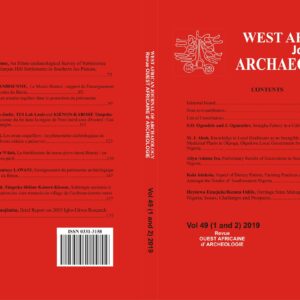
AA TABLE OF CONTENT VOLUME 49
S.O. Ogundele and J. Ogunsetire, Imiegba Pottery in a Cultural Perspective ……….1
M. J. Abah, Knowledge in Local Healthcare as an Intangible Heritage: Utilizing
Medicinal Plants in Okpoga, Okpokwu Local Government Area, Benue State,
Nigeria…………………………………………………………………………………………………………14Aliyu Adamu Isa, Preliminary Results of Excavations in Surame, Northwest
Nigeria…………………………………………………………………………………………………………….35Kola Adekola, Aspect of Dietary Pattern, Farming Practices and Organisations
Amongst the Yoruba of Southwestern Nigeria……………………………………………………44Ifeyinwa Emejulu/Ikenna Odife, Heritage Sites Management in South Eastern
Nigeria; Issues, Challenges and Prospects……………………………………………………………64Na’ankwat Yola Kwapnoe, An Ethno-archaeological Survey of Subsistence
Agriculture Among Qua’anpan Hill Settlements in Southern Jos Plateau, Nigeria…..73Mireille AMEDE E. GBANHOUNME, Le Musée Honmè : support de
l’enseignement du panégyrique dans les écoles du Bénin………………………………………85Aka Adjo BEBEWOU, Les musées togolais dans la promotion du patrimoine
culturel…………………………………………………………………………………………………………..97DAPA AkouaDibiaMarie-Joelle1, TUI Lah Louis2 and KIÉNON-KABORÉ
Timpoko Hélène3, La métallurgie ancienne du fer dans la région de Poro (nord-cote
d’ivoire) : Cas du site Kadjologo 1 de Poungbe…………………………………………………111N’doua Etienne ETTIEN, Les amas coquilliers : un phénomène archéologique de
premier plan de la Côte d’Ivoire côtière a préserver…………………………………………….123Aminou Gambari, Didier N’dah, La fortification de tunru-gbere (nord-Benin) : un
patrimoine archéologique en péril………………………………………………………………….133Colette GOUNOU, Abdoulaye LAWANI, Enseignement du patrimoine
archéologique dans les écoles et collèges du Bénin…………………………………………….147TIE Bi Galla Guy Roland, Timpoko Hélène Kaboré-Kienon, Sidérurgie ancienne à
Issia : protection et valorisation des sites menacés du village de Gazibouo (centre ouest
forestier de Côte d’Ivoire)………………………………………………………………………………..157Kingsley Chinedu Daraojimba, Brief Report on 2019 Igbo-Ukwu Research
Project…………………………………………………………………………………………………………..177 -
AA Table of Contents 45
Table of Contents 45
Okpoko, A.I. Archaeology and Anthropology: the Foot Prints and
Legacy of Bassey Wai Andah……………………………………….…….1
Okpoko, A.I. and Onu, A.O. Traditional Foundation for Christian Virtues
in Igboland: a Link from Bassey Andah’s Viewpoint on Religion
and Religious Life in Africa…………………………………………………23
Tubi, Paul-Kolade. Historicism, Structuralism and Post-Structuralism:
The Contribution of Bassey W. Andah to Deconstructing African
Anthropology……………………………………..…………………………..42
Ezeh, P.J. Indigenous Technology: Some Medical Examples of the
Orring And the Igbo……………………………………………………………………..57
Tubi, Paul-Kolade. Ethnography of the Dynamics of Politics and
Religion in Traditional Society: A Case Study of the OkunYoruba………………………………………………………………………………………..65
Ogundele, S. O. Towards Poverty Alleviation: Public Archaeology,
Heritage Management and Museum in Nigeria………………………………..86
Oyinloye, M.A. and Aremu, D.A. Ethnographic Study of
Wooden Objects’ Conservation: Focus on National Museums in
Lagos and Oron, Nigeria……………………………………………………………..102 -
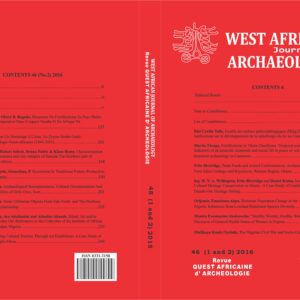
AA Table of Contents 46
Table of Contents 46
Tollo Eloi Cyrille. Métallurgie du fer dans la rive gauche de la Sanaga. Etude de
l’atelier de réduction du fer d’Elig-Zogo Philadelphia au Cameroun……………….1
Mandeng Jean Robert. Les fouilles archéologiques de Nkolandom: contribution
à la connaissance du peuplement ancien au sud Cameroun le cas des abris sous
roche de Dum Ebete Akok et Nkomeyos…………………………………………………..18
Elouga Martin. Fortifications in Tikars Chiefdoms. Temporal security borders
and indicators of an autarchic economic and social life in peace or war time.
A contribution to historical archaeology in Cameroon.………………………………34
Biveridge Fritz. Trade Feuds and Armed Confrontations: Archaeological
indications at Forts Eliza Carthago and Ruychaver, Western Region,
Ghana…………………………………………………………………………………………………….52
Wellington Ing. H. N. A., Fritz Biveridge and Daniel Kuma. Iconoclasm,
Antithesis to Cultural Heritage Conservation in Ghana – A Case-Study of
Conflicts Typology in the Danish-Osu Heritage Setting……………………………….69
Emuobosa Akpo Orijemie, . Holocene vegetation change in the forests of
southwest Nigeria: Inferences from Lowland Rainforest Species
Diversity……………………………………………………………………………………………..86
Pogoson Ohioma Ifounu. Interrogating Anthropomorphism in Benin and
Northern Edo Art: Some Tentative Notes for Historical Clarifications…………103Garba Abubakar. Archaeology Of The Chad Basin, North East Nigeria: Success
Story And Limitations…………………………………………………………………………….120 -
AA Table of Contents 47
Table of Contents
Orijemie Emuobosa Akpo: Farming Dynamics in the Middle Benue Valley, north-central Nigeria since the 15th Century AD………………………………………62
Abubakar Sule Sani: Contribution to Heritage and Islamic Archaeology of Bauchi Region, Northern Nigeria…………………………………………………………81
Ruivo Ferreira Burmann, André Luiz: Preliminary Comparative analyzes of Prehistoric Figurine Traditions in West Africa…………………………………100
Kabiru K. Salami: Traditional Birth Attendants and Maternal Health Service Delivery in a Community Health Project in South-western Nigeria: A qualitative study…………………………………………………………………………….121
Kafayat O. Oshodi, Kabiru K. Salami and Patricia A. Taiwo: Motherhood and the Practice of Grand Multiparity: Responses from Grand Multiparous Women in Ibadan, Nigeria………………………………………………………………….143
Olanrewaju Lasisi: History of Archaeological Research in the Yoruba-Edo region of Nigeria: New Directions for Urban Earthen works……………………………………169
Salamatou: Archéologie Historique Au Cameroun. Les Sites De L’occupation Allemande Dans Le Mbam (ndikiniméki, Bafiaet Nyamanga II)…………………199
-
AA Table of Contents 48
Table of Contents
Adande, Alexis: We, African Archaeologists, Who Do We Serve? ………………..1
Ogundiran¹ Akinwumi, Macham Mangut², and Olusegun Moyib³:
The Archaeological Landscape of Bara, near Oyo-Ile…………………..……….15
Holl, F. C. Augustin : Exercise, Violence, Illness, and Death: Mortuary Programs as Curriculum-Vitae …………………………………………………….33
Ogundele, S. Oluwole : Nigeria’s Place in the Sun: Colonial/Neo-colonial
Agendas, Contested Narratives and Post-Andah Archaeology ………..….45
Tubi, Fr. Paul-Kolade : Ethnoarchaeological Importance of Lokoja Rockshelters.
………………………………………………………………………………..…..57
John Kelechi Ugwuanyi: Hegemonic Heritage and Public Exclusion in Nigeria:
A Search for Inclusive and Sustainable Alternatives ………………………………..71
Fr. Paul-Kolade Tubi,:Field Archaeology in Israel: A Short Note. ……………109
José Farrujia de la Rosa: The Amazigh people of Western Africa: the early colonization of the Canary Islands. …………………………………………….121
N´zi Dibié Charles: Vers une nouvelle configuration de l’archéologie en Côte d’Ivoire ? ……………………………………………………………………….131
-
AA TABLES OF CONTENTS WAJA 51
Table of Contents
Pages
Editorial Board:………………………………………………………….…………………..…ii
Note to Contributors:……..…………………………………..… ………………………………iii
List of Contributors:………………………………….………………………..……………….iv
vi
vii
-
AA TABLES OF CONTENTS WAJA 52 – 2
Table of Contents
Pages
Editorial Board:………………………………………………………….…………………..…ii
Note to Contributors:……..…………………………………..… ………………………………iii
List of Contributors:………………………………….………………………..……………….iv
TABLE OF CONTENT
Kola Adekola: A Consideration of Ethical Issues in Archaeology and Anthropology
Ruivo Ferreira Burmann, André Luiz:
Preliminary comparative analyzes of prehistoric figurine traditions in Wester Africa.Kyazike Elizabeth: Kansyore Crescents: Multipurpose Functional Tools and
Technological Complexity.David Akwasi Mensah Abrampah and Mark Henry Freeman: Slaves and Grains:
Understanding the Role of Slaves and Grains in the History of Anomabu during the trans- Atlantic trade.ỌLÁLẸ́YẸ Samuel Káyọ̀dé and Oyelàdé Olúfikáyọ̀ Kúnlé : Gender Issues in Gẹ̀lẹ̀dẹ́
Ritual Masks, Songs and Dance: Their Implications for Social Harmony and Family StabilityMonica O. Aneni: Prosopography of the Somatophylakes of Alexander the Great.
Daniel Kenechukwu Chidiogo 1Ibeanu Anselm Maduabuchi and 1Eze-Uzomaka
Pamela: Analyses of Mineral Composition of Potsherds from Iron Smelting Site in
Ukehe and its Implications for Archaeological Investigation -
AA TABLES OF CONTENTS WAJA 52-1
Table of Contents
Pages
Editorial Board:………………………………………………………….…………………..…ii
Note to Contributors:……..…………………………………..… ………………………………iii
List of Contributors:………………………………….………………………..……………….iv
TABLE OF CONTENT
Akinwumi Ogundiran: Postcolonial Ordeal and the Emancipatory
Potentials of Archaeology/Anthropology Education in Nigeria.Babajide Olusoji Ololajulo: Oke Afa memorial arcade and the burden
of remembrance in Nigeria. Department of Archaeology and Anthropology
University of Ibadan.Orijemie Emuobosa Akpo: The Archaeobotanical and Palaeoecological Legacy
of ‘garden-based’ Agroforestry in the African RainforestKola Adekola: An Insight to 50 years of Archaeological Research in Nigeria
Olatomiwa K. Sarumoh and David Aremu:Ethnographic Study of Drum
Making and its Significance among the People of Oyo.Adeola Adeitan Lameed, Francesca Chinyere Ukpokolo and David A. Aremu: Àgbélé Symbol and the Branding of Ìyámòpó Mountain in Ìgbẹ́tì for Heritage Tourism.
-
AA- Table of Content 38 & 39|Articles
Table of Content 38 & 39
1 ————————————————– 24 Pottery Traditions of the Earthworks of Southern Ghana: Test
Excavation at the Site of Ngyeduam
J. Boachie-Ansah Department of Archaeology and Heritage Studies University of Ghana, Legon, Accra, Ghana25 ——————————————– 41 Challenges of Dating and Sequencing in West African Stone Age Archaeology Since the 1970s
Obarè B. Bagodo Departement d‟histoire et d‟archéologie Université d‟Abomey-Calavi, Bénin Republic42 ——————————————- 50 Interpreting Benin Art Objects In Catalogues and Books as
Indigenous Photographs Captured in Conventional Photography
Kokunre Agbontaen-Ekghofona
Department of Sociology and Anthropology University of Benin Benin City51 ——————————————— 57 Archaeological Survey of Nri
A.I. Okpoko, A. M. Ibeanu, C.E. Umeokafor
Department of Archaeology and Tourism University of Nigeria, Nsukka.58 —————————————– 73 Rethinking The Archaeology of Zaria Area: Evidence From Recent Archaeological Investigations
Dr K. T. Odofin Department of Archaeology, Ahmadubello University, Zaria74 —————————————- 88 Iron Working Traditions in Idomaland and Northern Igboland
Border Communities
Ibeanu, A.M. and Inalegwu, S.A -
AA- Table of Content 40 & 41|Articles
Table of Content 40 & 41
1 ————————————————- 14 Pottery Tradition and Heritage Management in Sukur Kingdom, Nigeria.
Pat Uche Okpoko Ph.D. and Emeka E. Okonkwo Department of Archaeology and Tourism
University of Nigeria, Nsukka.15 ———————————————– 23 Archaeological Excavations in parts of the Katsina Ala Basin, Benue Valley of Nigeria.
Jonathan Demenongo Ndera (Ph.D.) Department of Archaeology Ahmadu Bello University, Zaria.24 ——————————————– 32 Gender Representations in Death and Burial Rituals:
Perspectives from Some Cultural Groups in Ghana
Gertrude Aba Mansah Eyifa Department of Archaeology and Heritage Studies University of Ghana, Legon. Accra, Ghana33 ———————————————— 47 A Study of Ancient Subsistence Strategies of the Coastal Dangbe of Ghana: An Archaeological Perspective
Beveridge Fritz Department of Archaeology and Heritage Studies University of Ghana, Legon, Accra, Ghana48 ————————————————55 Traditional Potters of Eggonland: An Ethnoarchaeological Investigation
Ibeanu, A. M. Department of Archaeology and Tourism,
University of Nigeria, Nsukka. and Gershom D. Dalat Department of History, Nasarawa State, University, Keffi.56 ———————————————- 66 Preliminary Report of Archaeological Investigations of Esie, North Central Yorubaland
Adekola, K. and Aleru, J. O. Department of Archaeology and Anthropology University of Ibadan,Ibadan, Nigeria67 ———————————————– 74 Stone Fortification of Surame, Northwestern Nigeria
Olusegun Opadeji75 ———————————————– 84 Africa and Archaeology: Empowering an Expatriate
Merrick Posnansky
Book Reviewed by Prof. C.A. Folorunso
