

-
2019 Igbo-Ukwu Research Project
$10.00Short Notes on the 2019 Igbo-Ukwu Research Project
Kingsley Chinedu Daraojimba
Department of Archaeology and Tourism
University of Nigeria. Nsukka
[email protected]
Introduction
Igbo-Ukwu is a world renowned archaeological site which lies about 40 kilometres east of the
lower Niger River in Anambra State, Nigeria (Fig. 1). The Igbo-Ukwu Archaeological and
Heritage Project began its first phase in November 2019. The revisit to the site was the first
after six decades the original excavations were conducted by Professor Thurstan Shaw.
Between 1959 and 1964, Shaw’s excavations in the three sites (Igbo Richard, Igbo Isaiah and
Igbo Jonah) revealed a royal burial chamber and large collection of intricately decorated
pottery, bone and ivory, objects of copper, iron and elaborate bronze art, fabric, carnelian, stone
and coloured glass beads dated over 1000 years old (Shaw 1970; 1977). In response to poor
attention to the renowned Igbo-Ukwu sites, a community-engaged archaeology project was
conceptualised by Shaw’s widow, Pamela Jane Smith, in consultation with compound owners,
the Traditional Ruler and the Anozie family.
Community archaeology though far from new in Africa, where archaeologists such as Thurstan
Shaw and Merrick Posnansky have practised it (Schmidt 2014), many researchers still poorly
engage local and indigenous communities in their research approach (Pikirayi and Schmidt
2016). There are several hindrances responsible for this poor community-researcher
engagement. Some of such hindrances among others include mistrust arising from damaging
experiences under colonial rule, looting and sale of cultural items and non-obedience to the
culturally or socially prohibited rules guiding the preservation of cultural heritage (Aleru and
Adekola 2016). Community archaeology is archaeology of the people, for the people and by
the people. In other words, it is an archaeological activity that is focused on drawing a
connection between communities and archaeological remains for the purose of benefitting the
local community and preservation of their archaeological heritage (Lewis, 2018). Since
community archaeology was more about what the community needs and not what the
archaeologist thinks the community needs (Smith et al. 2020), this ten day inclusive community
approach was targeted at handing over, at least, partial control of the project to the local
community. This approach was targeted at promoting indigenous views in interpretations and
to empower communities to benefit from and participate in developing their ownarchaeological sites. The approach is important as the first phase of the efforts to launch a long-
term archaeological project in Igbo-Ukwu. This paper briefly describes the first phase of theproject and highlights the possibilities in the area for future archaeological research.
-

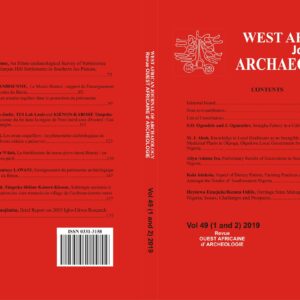
AA TABLE OF CONTENT VOLUME 49
S.O. Ogundele and J. Ogunsetire, Imiegba Pottery in a Cultural Perspective ……….1
M. J. Abah, Knowledge in Local Healthcare as an Intangible Heritage: Utilizing
Medicinal Plants in Okpoga, Okpokwu Local Government Area, Benue State,
Nigeria…………………………………………………………………………………………………………14Aliyu Adamu Isa, Preliminary Results of Excavations in Surame, Northwest
Nigeria…………………………………………………………………………………………………………….35Kola Adekola, Aspect of Dietary Pattern, Farming Practices and Organisations
Amongst the Yoruba of Southwestern Nigeria……………………………………………………44Ifeyinwa Emejulu/Ikenna Odife, Heritage Sites Management in South Eastern
Nigeria; Issues, Challenges and Prospects……………………………………………………………64Na’ankwat Yola Kwapnoe, An Ethno-archaeological Survey of Subsistence
Agriculture Among Qua’anpan Hill Settlements in Southern Jos Plateau, Nigeria…..73Mireille AMEDE E. GBANHOUNME, Le Musée Honmè : support de
l’enseignement du panégyrique dans les écoles du Bénin………………………………………85Aka Adjo BEBEWOU, Les musées togolais dans la promotion du patrimoine
culturel…………………………………………………………………………………………………………..97DAPA AkouaDibiaMarie-Joelle1, TUI Lah Louis2 and KIÉNON-KABORÉ
Timpoko Hélène3, La métallurgie ancienne du fer dans la région de Poro (nord-cote
d’ivoire) : Cas du site Kadjologo 1 de Poungbe…………………………………………………111N’doua Etienne ETTIEN, Les amas coquilliers : un phénomène archéologique de
premier plan de la Côte d’Ivoire côtière a préserver…………………………………………….123Aminou Gambari, Didier N’dah, La fortification de tunru-gbere (nord-Benin) : un
patrimoine archéologique en péril………………………………………………………………….133Colette GOUNOU, Abdoulaye LAWANI, Enseignement du patrimoine
archéologique dans les écoles et collèges du Bénin…………………………………………….147TIE Bi Galla Guy Roland, Timpoko Hélène Kaboré-Kienon, Sidérurgie ancienne à
Issia : protection et valorisation des sites menacés du village de Gazibouo (centre ouest
forestier de Côte d’Ivoire)………………………………………………………………………………..157Kingsley Chinedu Daraojimba, Brief Report on 2019 Igbo-Ukwu Research
Project…………………………………………………………………………………………………………..177 -
An Ethno-archaeological Survey of Subsistence Agriculture Among Qua’anpan Hill Settlements in Southern Jos Plateau, Nigeria
$10.00An Ethno-archaeological Survey of Subsistence Agriculture Among Qua’anpan
Hill Settlements in Southern Jos Plateau, Nigeria
By
Na’ankwat Yola Kwapnoe
Department of Archaeology and Heritage Studies
University of Jos.
Email: [email protected]
Phone No: +2347068150891Abstract
Early agricultural practices are a defining factor for early human settlements around
the world. Today, many agricultural/farming communities dominate Africa but the
history of their success as agriculturists is not documented in order to trace the
foundation upon which this is built and to further develop it. Presently, most farming
activities in Qua’anpan, located on the southern edge of the Jos Plateau, is done on
plain frontier lands on the Benue trough. However, this paper seeks to discuss early
indigenous agricultural practices among the inhabitants of the hill settlements
(homeland) of present day Qua’anpan, particularly the pan people because this
formed the foundation for the large scale and mostly commercial agriculture that is
practiced today among the people. This includes their system of crop farming, animal
domestication, types of crops produced and other subsistence practices such as
storage practices and the continuity of such.Using surface archaeological and
ethnographic data, this work reveals subsistence agricultural practices that were
developed traditionally by the peopleand still sustained centuries later. It is hoped that
the knowledge of traditional agriculture among the Pan which involves
commercialization born from food sufficiency can be adopted to solve some of Africa’s
food problems and bring about development in health and education.
Keywords: Pan, Subsistence, agriculture, ethno-archaeology, Jos Plateau, food
sufficiency -
Aspect of Dietary Pattern, Farming Practices and Organisations Amongst the Yoruba of Southwestern Nigeria
$10.00Aspect of Dietary Pattern, Farming Practices and Organisations Amongst the
Yoruba of Southwestern Nigeria
Kola AdekolaDepartment of Archaeology and Anthropology
University of Ibadan
E mail: [email protected]Abstract
The Yoruba of Southwestern Nigeria exploit a wide range of resources in the quest for
sustenance, nourishment and survival. These resources featured prominently in their
dietary complexes and other cultural manifestations. Studies carried out in selected
cities of Southwestern Nigeria revealed a pattern of maintaining equilibrium with the
environment while cultural and other historic sources gave insights into the food items
introduced to the Yoruba dietary complexes. This paper throws light on some of these
as well as changes in the dietary pattern occasioned by cultural contacts and
modernity.
Keywords: Diet; Culture; Environment; Food Taboos; Yoruba -
Enseignement du patrimoine archéologique dans les écoles et collèges du Bénin
$10.00Enseignement du patrimoine archéologique dans les écoles et collèges du Bénin
Colette GOUNOU
Conservateure du MuséeethnographiqueAlexandreSènou ADANDE à la retraite
Porto-Novo/ République du Bénin Afrique de l’Ouest
E-mail : [email protected], Téléphone : +229 96392073Abdoulaye LAWANI
Abdoulaye Enseignant de Collèged’enseignementgénéral
Porto-Novo/République du Bénin Afrique de l’Ouest
E-mail : [email protected] Téléphone : +229 97529547Résumé
Cette communication présente des expériences de muséo-pédagogie centrées sur le
patrimoine culturel tangible et intangible effectuées au cours d’expositions portant sur
la présentation publique de résultats de recherches archéologiques et/ou
ethnographiques ou historiques au Bénin ou ailleurs en Afrique (Niger, Afrique du
Sud) ou dans le monde (Pologne, Suède). La pertinence de cette orientation
muséographique/muséale est évidente pour tout pédagogue et éducateur expérimenté.
On doit faire le plaidoyer pour une généralisation de l’éducation au patrimoine, non
seulement au Bénin, mais au-delà des frontières des pays pour donner tout son sens à
l’initiative de l’UNESCO, (Convention de 1972). Il est question à travers le patrimoine
d’éduquer mais aussi de libérer tout le potentiel (artistique, scientifique, technique,
etc.) chez les bénéficiaires, citoyens d’aujourd’hui et à travers les jeunes, des citoyens
du Monde, complets de demain.
Mots clés : éducation au patrimoine, muséo-pédagogie, archéo-pédagogie, Bénin,
Afrique. -
Heritage Sites Management in South Eastern Nigeria; Issues, Challenges and Prospects. Heritage Sites Management in South Eastern Nigeria; Issues, Challenges and Prospects.
$10.00Heritage Sites Management in South Eastern Nigeria; Issues, Challenges and
Prospects.
BYIfeyinwa Emejulu (Ph.D)
(Professor of Archaeology and Tourism)
Department of History and International Studies
Nnamdi Azikiwe University, Awka
Email: [email protected]
+2348033420322
And
Ikenna Odife
(Senior Lecturer)Department of History and International Studies
Nnamdi Azikiwe University, Awka
Email: [email protected];[email protected]+2348035499792
Abstract
Heritage sites contain the repository for understanding of the material culture of past
generations. This is against the aptness and reliability they have over other sources of
information gathering on the past. Quite a few of such sites exist in southeastern
Nigeria. They have contributed immensely in the reconstruction of the history, culture,
economy, trade and intergroup relations of the societies within and outside the region.
The nation’s legislations, Bye-Laws and Acts on Museums and Antiquities declare
such sites public property and confer their ownership and management on government
agencies. Academic disciplines and Professional Academic societies compliment
government’s effort in this direction.Yet, these sites appear to suffer insouciance. This
hampers their availability to researchers, investigators and tourists and also provide
opportunities for unwarranted interference from interlopers. This paper interrogates
the reasons for this state of affairs and what these conditions portend for Heritage
sites. It uses data derived from primary and secondary sources whose contents are
thoroughly analyzed. It does not lend its presentation to any theoretical construct but
assesses and analyzes the content of the data. It argues that the declining interest in
the management of Heritage sites stem from the acute financial challenges that beset
government agencies. Allied to the above is the fact that professional curators are not
engaged in the management of museums and antiquities. This not only hampers the
management of sites but also limits the capacity of the agencies to identify heritage
sites so as to secure and manage sites.
Key Words: Repository Heritage, Management, Sites. -
Imiegba Pottery in a Cultural Perspective
$10.00Imiegba Pottery in a Cultural Perspective
S.O. Ogundele and J. Ogunsetire
Department of Archaeology and Anthropology
University of Ibadan, NigeriaAbstract
Pottery manufacture is an exciting, but tedious indigenous knowledge system among
the people of Imiegba in Edo State, Nigeria. This paper tries to capture facets of the
patterns of change and/or continuity in pottery productions in the study area.
Available oral traditional, oral historical, ethnographic, and written evidence suggests
that this knowledge system began here, not later than 200 years ago. This was based
on some limited genealogical data. However, more genealogical data are needed in
the future in order to construct a relatively clearer chronological picture. Five basic
stages of production have been identified and studied by us. Aside from this, clay
vessels are occasionally produced directly near the banks of River Obe – the source of
clay. This is called the off-site experience. The difficult terrain makes transportation a
Herculean task to accomplish in the area. In addition, some clay vessel types are no
longer produced (due to the introduction of plastic wares to the locality) except on
special requests. Pottery productions in Imiegba straddle the domains of art, science,
technology, symbolism and religion. There are taboos guiding pottery manufacture
with a view to promoting hygienic behaviours within the community. Some pots like
ilolo are still being manufactured because they cannot be replaced by plastic vessels.
Ilolo are perforated and painted with a white colour for rituals especially burial
ceremonies. This is one cultural element that continues to define the Imiegba group
identity despite the vagaries of modernity. -
Knowledge in Local Healthcare as an Intangible Heritage: Utilizing Medicinal Plants in Okpoga, Okpokwu Local Government Area, Benue State, Nigeria
$10.00Knowledge in Local Healthcare as an Intangible Heritage: Utilizing Medicinal
Plants in Okpoga, Okpokwu Local Government Area, Benue State, NigeriaM. J. Abah
Department of Archaeology, Faculty of Arts
Ahmadu Bello University, Zaria
Email: [email protected], +2348033582437Abstract
Knowledge is power and health they say, is wealth. Knowledge and skill are key to
economic and social development; they are heritage resources. This study examined
the knowledge of the Okpoga people in traditional herbal medicine. The specific
objectives were to: identify medicinal plants, assess the medicinal value of the plants
and classify the plants. Qualitative data was collected via oral interview with 24
medical practitioners and participants’ observation of some of the activities. Plant
samples were collected via a transect walk through the vegetation of the area. The
people had knowledge in the application of 33 medicinal plants for the treatment of
several ailments. The 33 plants can treat 43 different ailments including sickle cell
anaemia in the area.. They have also been able to reserve more income for other needs
and have experienced an improved living standard. This knowledge is a heritage in
Africa. As a repository of cultural heritage as well as a decision-making body, the
United Nations Educational, Scientific and Cultural Organization (UNESCO) should
ensure that this knowledge is preserved and protected through proper patent right. -
La fortification de tunru-gbere (nord-Benin) : un patrimoine archéologique en péril
$10.00La fortification de tunru-gbere (nord-Benin) : un patrimoine archéologique en
péril
AminouGambariÉtudiant en Master-Archéologie/ Université d’Abomey Calavi
[email protected]
Didier N’dahMaître de conférences en Préhistoire
Département d’Histoire et d’Archéologie, / Université d’Abomey Calavi
Résumé
Tunru-Gbere (Tunru), situé à 7 km à l’Ouest de Parakou-centre (Nord-Bénin),fut
l’œuvre d’un fugitif wasangari de Niki vers le XVIII éme siècle. Tunru-Gbere était
une cité à péage qui s’est dotée dans la première moitié du XIX ème d’une enceinte
fortifiée sous OkorikoDumgbare. Constituée d’un fossé extérieur et d’une muraille,
cette enceinte était un véritable dispositif sécuritaire de Tunru qui permit à sonpéage (sa douane) de prospérer sur la piste caravanière Kparaku(Parakou) -Zugu-
Wangara (Djougou) jusqu’à la conquête française du Baruwu en 1898. L’état dedégradation très avancée de cet ouvrage militaireest dûaux facteurs naturels,
animaliers etanthropiques, vu l’ignorance de l’importance de ce patrimoine
culturel par les populations.La disparition quasi-totale de cette enceinte pose le
problème du patrimoine en péril dans la ‘’cité des Ture’’. Son patrimoine
historique et culturel n’est pas valorisé. C’est pourquoi des propositions d’actions à
mener ont été faites poursa sauvegarde et sa valorisation.
Mots clés : Fortification ; Patrimoine ; archéologique, nord-Benin. -
La métallurgie ancienne du fer dans la région de Poro (nord-cote d’ivoire) : Cas du site Kadjologo 1 de Poungbe
$10.00La métallurgie ancienne du fer dans la région de Poro (nord-cote d’ivoire) :
Cas du site Kadjologo 1 de Poungbe
DAPA AkouaDibiaMarie-Joelle1
[email protected]/
TUI Lah Louis2
[email protected]/
KIÉNON-KABORÉ Timpoko Hélène3
Unité Pédagogique Archéologie Institut des Sciences Anthropologiques de
Développement (ISAD) Université Félix Houphouët-Boigny, Cocody-Abidjan,
Résumé
Depuis environ 100 ans, des prospections archéologiques ont été entreprises en
Côte d’Ivoire et ont mis au jour d’importants sites et vestiges dont l’étude permet
d’appréhender l’histoire des savoirs et savoir-faire des civilisations antérieures.
En ce qui concerne la métallurgie ancienne du fer, les recherches sont assez
récentes. La zone d’Odienné et de Korhogo ont bénéficié de plusieurs campagnes
de prospections et de fouilles en collaboration avecdes chercheurs suisses et
burkinabés.
Pendant ces campagnes, plusieurs sites de la métallurgie ancienne du fer dans ces
localités, ont été identifiés, analysés et décrits. A l’état actuel des recherches,
plusieurs traditions techniques ont été identifié à Odienné à l’issu de plusieurs
fouilles effectuées.
Quant à la région du Poro,des sites de la métallurgie ancienne du fer ont été
également identifiés, mais n’ont pas fait l’objet d’études approfondies. Il est donc
question ici d’approfondir les études déjà menées dans cette zone par des
prospections et analyses de l’espace afin de comprendre les traditions techniques
développées dans cette partie de la Côte d’Ivoire.
Notre objectif dans cette approche, est de faire une description du site de
Kadjologo1 et des structures qui le composent.
Mots clés: Métallurgie ancienne du fer ; tradition technique ; structure circulaire ;
Kadjologo 1. -
Le Musée Honmè : support de l’enseignement du panégyrique dans les écoles du Bénin
$10.00Le Musée Honmè : support de l’enseignement du panégyrique dans les
écoles du Bénin
Mireille AMEDE E. GBANHOUNME
Conservateur au Musée Honmè,
Ancien Palais Royal de Porto-Novo (Bénin)
E-mail : [email protected] / Tél : +229 97 17 58 61Abstract: Archaeology latosensu and cultural heritage education in schools.
In a fast-changing world, the human brain is permanently incited to find out
original solutions in order to adapt oneself to the new environment and make it
more viable. The cultural heritage is also a kind of teaching tool very useful for
stimulating the intellectual and creative functions of a person or a child.
The discovering of the cultural patrimony helps the school boy/girl to satisfy his/her
need to investigate, compare, and be trained by oneself, either alone or in
collaboration with his/her fellows. To know their own culture is a source of
inspiration to bring peoples of different traditions closer for social harmony.
The sustainability of the cultural heritage is a huge challenge in the process of
development, mainly in the present day context of globalization which is erasing the
local cultural features. The cultural heritage development must take stock of the
youth’s heritage education through their own cultural identity in order that they
know their everyday environment better. That is why the outreach programme of the
Honmè Museum (Afinɔba) in Porto-Novo goes to schools and plans cultural
activities. Among those activities are : story telling in African languages, traditional
games and dances, calligraphy, and competitions in clans’ panegyrics
(akɔmimlan/oriki).
Our main focus is on the public school since they are the adults of tomorrow and at
the same time they have a strong capacity to disseminate the newly acquired
knowledge among their parents and friends.
Do we not have situations where we are seeking overseas solutions when they are
available at hand?
There is no plain societal expansion without taking into account the cultural
heritage development. The economic progress alone cannot determine the concept
human development.
Key words: heritage education, development, culture, youth of the schools, Honmè
Museum, Porto-Novo. -
Les amas coquilliers : un phénomène archéologique de premier plan de la Côte d’Ivoire côtière a préserver
$10.00Les amas coquilliers : un phénomène archéologique de premier plan de la
Côte d’Ivoire côtière a préserver
N’douaEtienne ETTIEN
ArchéologueUnité Pédagogique d’Archéologie de l’Institut des Sciences Anthropologiques
de Développement (ISAD) Université Félix Houphouët-Boigny
Cocody-Abidjan – Côte d’Ivoire / [email protected]Résume
Les amas coquilliers de Côte d’Ivoire, poubelles à ciel ouvert du néolithique et restes
du quotidien des populations de la côte ivoirienne, sont présents sur environs 300 km
de rivage lagunaire. On dénombre le long de la côte plus d’une soixantaine de sites
qui se trouvent aujourd’hui dans un état de quasi destruction.
En effet, depuis le début des indépendances, le gouvernement a mis sur place une
politique d’exploitation des sites coquilliers du pays pour combler ses besoins en
calcaire. A cette action de l’état ivoirien qui s’est étendue sur plus d’une décennie, on
n’observe désormais un regard nouveau des populations dans leur rapport avec les
sites coquilliers, suscitant une grande chaîne d’exploitation de ces coquillages.
Ce nouveau regard des populations locales sur les sites coquilliers constitue, une
réelle menace quant à leur préservation pour la science et les générations futures. Il
est ainsi indiqué de s’interroger sur les stratégies à mettre en œuvre pour une
meilleurepréservation des coquillières de Côte d’Ivoire. Les enquêtes de terrain ont
abouti à la mise en évidence de l’ampleur de la destruction avancée des sites et leur
impact néfaste sur le patrimoine archéologique du sud du pays.
Mots-clés : Amas coquilliers, Archéologie, Préservation, Songon, Côte d’Ivoire côtière. -
Les musées togolais dans la promotion du patrimoine culturel
$10.00Les musées togolais dans la promotion du patrimoine culturel
Aka Adjo BEBEWOU
Doctorante au Département d’Histoire et d’Archéologie de l’Université de
Lomé,Togo (+228) 91 92 58 73, [email protected]Résumé
Parmi les évènements et les structures culturelles mises en place par les dirigeants
africains pour sauver leur pays des dommages causés par la traite négrière et la
colonisation, on peut citer la revalorisation de la culture qui passe par l’affirmation
d’une authenticité culturelle. L’un de ces structures reste sans doute les musées qui
sont non seulement à la fois acteurs du développement mais aussi au carrefour des
systèmes politiques, économiques, social et garants des us et coutumes des
communautés. Cette industrie culturelle est le miroir de toute société et par
conséquent, capable de créer une cohésion nationale. Pour rendre leur structure
muséale crédible, les dirigeants africains ont adhéré au Centre international d’études
pour la conservation et la conservation des biens culturels (ICCROM). Cependant,
quelques décennies après la promulgation de ces différents décrets, l’on constate que
certains musées africains sont à l’état embryonnaire. D’où l’objectif de cette approche
pour faire ressortir à travers le cas togolais, les limites des administrations dans la
promotion du patrimoine culturel par le biais des musées. Dans ce travail, nous allons
montrer l’état actuel des structures muséale, les handicapes à leur évolutions qui
entraine leur faible participation à la réussite de la politique patrimoniale au Togo.
Mots clés : musée, patrimoine, culturel, revalorisation, authenticité. -
Preliminary Results of Excavations in Surame, Northwest Nigeria
$10.00Preliminary Results of Excavations in Surame, Northwest Nigeria
Aliyu Adamu Isa
Department of Archaeology, Ahmadu Bello University, Zaria-Nigeria.
Email: [email protected]; [email protected]Abstract
This paper presents a preliminary result of archaeological excavations carried out at
the site of Surame, northwest Nigeria. The excavations of a trench of 2 X 3 metres and
a sqaure of 3 X 3 metres directed at historically identified former residence of the
chief, and palace officials were undertaken, and targeted towards the exposure of
archaeological sequence and recovery of materials that will represent occupation as
fully as possible. The research aims to improve our understanding of ancient
settlements in Nigeria in particular and West Africa in general.
Introduction
Until the decline of the Songhay around 1591AD, often referred to as the “final great
medieval empire of West Africa” (Insoll, 2011: 29), not much in terms of early cultural
achievements is mentioned in the historical record regarding its neighbours such as the
Kebbi polity with its early capital, Surame (see also Gronenborn 2011: 41; Haour
2011: 67). When they are mentioned in historical writings, e.g Palmer (1916); Arnett
(1920); Alkali (1969); and Augi (1984), the authors emphasize political rivalries
amongst various northern Nigeria polities. Although the process of state formation in
Africa had involved complexity of factors including warfare that had relevance in the
making and consolidation of political power and territorial expansion of pre-colonial
states, there is indeed no doubt that, the military factor cannot alone explain the entire
history of any African State such as Kebbi (Aliyu and Shehu, 2017). Thus, the specific
objectives of this project were to identify the traditions of pottery in Surame; and its
role in West Africa’s pre-colonial trading system; as well as to reconstruct the
subsistence economy of the people. -
Sidérurgie ancienne à Issia : protection et valorisation des sites menacés du village de Gazibouo (centre ouest forestier de Côte d’Ivoire)
$10.00Sidérurgie ancienne à Issia : protection et valorisation des sites menacés du
village de Gazibouo (centre ouest forestier de Côte d’Ivoire)TIE Bi Galla Guy Roland
Docteur en Archéologie
Institut des Sciences Anthropologiquesde Développement (ISAD) Université Félix Houphouët-Boigny
Cocody-Abidjan- Côte d’Ivoire / [email protected]Timpoko Hélène Kaboré-Kienon
Professeur Titulaire en Archéologie
Institut des Sciences Anthropologiquesde Développement (ISAD) Université Félix Houphouët-Boigny
Cocody-Abidjan- Côte d’Ivoire / [email protected]Résumé
Les recherches effectuées à Issia, dans le centre-ouest forestier de la Côte d’Ivoire, ont
révélé la richesse de celle-ci en vestiges archéologiques en général et en vestiges
sidérurgiques en particulier. A ce titre, de nombreux amas de scories, ont été
répertoriés dans le village de Gazibouo. Ces vestiges indiquent que cette zone a connu
d’intenses activités métallurgiques dès les premiers moments de la protohistoire. Les
datations au carbone 14 font remonter l’activité des premiers métallurgistes de cette
zone à une période comprise entre le Vème et le VIIIème siècle de notre ère.
Toutefois, fort est de constater une dégradation accélérée de ce riche patrimoine du
fait de l’action humaine. D’où l’épineuse question de la protection et de la
valorisation des sites sidérurgiques de cette zone.
L’objectif poursuivi dans cette étude, est d’inventorier dans un premier temps, les sites
sidérurgiques de la zone d’Issia et dans un second temps, de déterminerles actions a
mener en faveur de la protection et de la valorisation des sites menacés. Ce qui
permettra à l’opinion et aux générations futures de s’imprégner des traditions
techniques des métallurgistes d’alors dans cette région.
Mots-clés : Métallurgie ancienne du fer, Région d’Issia, Gazibouo, patrimoine
archéologique, sites menacés.