

Best Seller Items
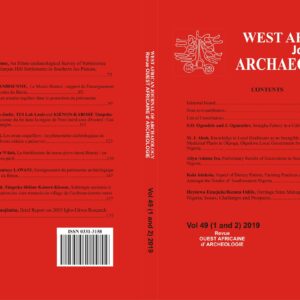

WAJA VOLUME 48
$50.00-
Historicism, Structuralism and Post-Structuralism: The Contribution of Bassey W. Andah to Deconstructing African Anthropology
$10.00Paul-Kolade Tubi, Ph.D*
Federal University, Lokoja, Kogi State,Abstract
“Colonial and indeed all European anthropologists working in Africa and Asia
interpreted and still interpret behaviour in relation to their own interests and
experiences; their ideas are not truths self-evident in the cultures they studied”
(Bassey W. Andah, 1988:10). It is incumbent on African anthropologists,
archaeologists, historians and social scientists to become seriously preoccupied
with deconstructing African cultural studies. This task was eminently championed
by scholars like Cheik Anta Diop, Walter Rodney, Bassey W. Andah and Chinweizu
amongst others. Professor Andah is said to be the first African doctoral
anthropologist with specialization in Archaeology. He taught at universities in
Ghana and Nigeria. He became a professor in 1978. He was the founding president
of the Archaeological Association of Nigeria and secretary of the Pan-African
Association of Pre-History and Related studies. He was the first African editor of
the West African Journal of Archaeology (WAJA).The writer assesses what he
considers the major contributions of Andah to African Anthropology. -

WAJA VOLUME 52 2 FULL
$50.00WEST AFRICAN JOURNAL OF ARCHAEOLOGY
REVUE OUEST AFRICAINE d’ ARCHEOLOGIEISSN 0331-3158
Edited by
David A. AremuAssisted by
Jonathan O. Aleru and Aicha Toure Gninin
Volume 52(1) 2022
Published on Behalf of West African Archaeological Association by the Editorial Board of WAJA
Editorial
1. Editorial Board
Ballouche, A. – Universite d’ Angers, France
Boachie-Ansah, J. – University of Ghana, Legon, Accra
Derefaka A.A. – University of Port Harcourt, Nigeria
Jemkur, J. – University of Jos, Nigeria
Okafor E.E. – University of Nsukka, Nigeria
Apoh W. – President, W.A.A.A. (Ex-Officio)
Kouassi K.S. – Treasurer, W.A.A.A. (Ex-Officio)
2. Advisory Board
Professor H. Bocoun
Professor T. Champion
Professor A.F.C. Holl
Professor J.B. Kiethega
Professor M.A. Sowunmi
Professor J. Mangut
Professor Isa Tijani
Editor-In-Chief: – David A. AremuUniversity of Ibadan, Nigeria
Associate Editors: – Jonathan O. Aleru (Anglophone)
University of Ibadan, Nigeria
– Aicha Toure GnininAssistante, Institut des Sciences
Anthropologiques de
Development (ISAD)
UFR-SHS Universite Felix
Honphouet – Biology Cocody –
Abidjan, Cote d’ IvoireBusiness Manager: – R.A. Alabi,
University of Ibadan, Nigeria
Assist. Business Managers: – Kingsley C. Daraojimba
University of Nigeria, Nsukka
Z. A. Gundu,
Ahmadu Bello University, Zaria,
NigeriaNote to Contributors
Contributors are advised to follow our format in preparing their contributions. We do not
accept footnote referencing. All references must be compiled alphabetically at the end of the
paper with the surname of the authors coming first, followed by year of publication, then the
title of paper and the medium of publication. ALL ILLUSTRATIONS MUST BE DIGITIZED AND
SHOULD HAVE GOOD CONTRAST AND NOT BE TOO MANY. THEY SHOULD BE AT THE END OF
THE TEXT BEFORE THE LIST OF REFERENCES. An electronic copy of the text and the illustrations
should be sent with two hardcopies.
The software used must be indicated. However, we advise any of the following: Microsoft
Office-MS-Word, Adobe Page Maker7 or Word Perfect 8. All contributions not conforming to
the above requirements will be rejected.
Papers are to be submitted to the Editor-in-Chief:
Prof David A. Aremu; email, ([email protected])
Department of Archaeology and Anthropology,
University of Ibadan, Nigeria.
Or
The Business Manager,
Prof Raphael A. Alabi, email, ([email protected])
Department of Archaeology and Anthropology,
University of Ibadan, Nigeria.Waja Volume 52(1)
LIST OF CONTRIBUTORSAkinwumi Ogundiran : University of North Carolina, Charlotte, United
State of America.
Babajide Olusoji Ololajulo: Department of Archaeology and
Anthropology, University of Ibadan, Nigeria.
Orijemie Emuobosa Akpo: Department of Archaeology and Anthropology,
University of Ibadan, Nigeria.
Kola Adekola: Department of Archaeology and Anthropology,
University of Ibadan, Nigeria.
Olatomiwa K. Sarumoh and David Aremu Department of Archaeology
and Anthropology, University of Ibadan.
Adeola Adeitan Lameed, Francesca Chinyere Ukpokolo and David A. Aremu:
Department of Sustainability Studies, University of Ibadan and Department of
Archaeology and Anthropology, University of Ibadan.TABLE OF CONTENT
Akinwumi Ogundiran: Postcolonial Ordeal and the Emancipatory
Potentials of Archaeology/Anthropology Education in Nigeria.
Babajide Olusoji Ololajulo: Oke Afa memorial arcade and the burden
of remembrance in Nigeria. Department of Archaeology and Anthropology
University of Ibadan.
Orijemie Emuobosa Akpo: The Archaeobotanical and Palaeoecological Legacy
of ‘garden-based’ Agroforestry in the African Rainforest
Kola Adekola: An Insight to 50 years of Archaeological Research in Nigeria
Olatomiwa K. Sarumoh and David Aremu: Ethnographic Study of Drum
Making and its Significance among the People of Oyo.
Adeola Adeitan Lameed, Francesca Chinyere Ukpokolo and David A. Aremu: Àgbélé
Symbol and the Branding of ÌyámòpóMountain in Ìgbẹ́tìfor Heritage Tourism.Waja Volume 52(2)
LIST OF CONTRIBUTORS
Kola Adekola: Department of Archaeology and Anthropology
University of Ibadan
Ruivo Ferreira Burmann, André Luiz: Goethe University in Frankfurt am
Main/Germany.
Kyazike Elizabeth: Department of History and Political Science, Kyambogo
University.
David Akwasi Mensah Abrampah and Mark Henry Freeman: Department of Archaeology andHeritage Studies University of Ghana and Cirrus Oil Company, Ghana.
ỌLÁLE Ỵ́ Ẹ Samuel Káyo ḍ́ é and Oyelàdé Olúfikáyo
̣́Kúnlé: Department of Religious
Studies, University of Ìbàdàn̩ , Ìbàdàn̩ , Òỵ ó
̣State, Nigeria; Chapel of the Resurrection,
University of Ibadan, Nigeria.
Monica O. Aneni: Department of Classics, University of Ibadan, Ibadan, Nigeria.
Daniel Kenechukwu Chidiogo 1Ibeanu Anselm Maduabuchi and 1Eze-Uzomaka
Pamela: Department of Archaeology and Tourism, University of Nigeria, Nsukka -
Analyses of Mineral Composition of Potsherds from Iron Smelting Site in Ukehe and its Implications for Archaeological Investigation
$10.00Analyses of Mineral Composition of Potsherds from Iron
Smelting Site in Ukehe and its Implications for ArchaeologicalInvestigation
1*Daniel Kenechukwu Chidiogo 1Ibeanu Anselm Maduabuchi and
1Eze-Uzomaka Pamela
1Department of Archaeology and Tourism, University of Nigeria,
Nsukka
Analyses and classification of pots/potsherds from archaeological
excavations in most cases have been limited to the physical attributes
possessed by the pottery wares, such as decorative motifs and pottery
forms which further informs the functions of the pottery. Although
these criteria played significant role in archaeological interpretation,
there is limited research on the use of scientific techniques to interpret
the mineral components of potsherds, especially within the Nigerian
context. Therefore, in this research, we conducted fieldwork and did
excavation (which lasted for 3months) in Ukehe town of Igbo-Etiti
Local Government Area of Enugu State, and collected iron samples
and potsherds for analysis. We applied scientific techniques – X-Ray
Diffraction (XRD) and Scanned Electron Microscopy (SEM) – to
analyse the mineral composition of the potsherds and further broaden
the scope of our interpretation to highlight the sources of raw materials
and trade relationships between/within human societies (Ukehe and
neighbouring communities). Drawing from our results, we conclude
that the use of scientific technique is vital in archaeological
interpretation as it has the potential to expose more information about
the material remains discovered in different parts of South-eastern
Nigeria and their composition.
Keywords: Potsherd, X-Ray Diffraction, Micrograph, Ukehe, iron
smelting -
Prosopography of the Somatophylakes of Alexander the Great
$10.00Prosopography of the Somatophylakes of
Alexander the Great
Monica O. Aneni
Department of Classics
University of Ibadan
Email: [email protected]Abstract: Ancient authors such as Arrian, Polybius, Plutarch
and several others have dedicated a huge amount of literature
to the exploits and politics of Alexander the Great. Modern
scholars, drawing from the narrations of ancient authors, have
analysed several aspects of the times and life of this great leader
and those of his Diadochi. However, little attention has been
paid to the men who served as his bodyguards. This paper is
therefore designed to examine the biographies of the
somatophylakes of Alexander the Great, with a view to
understanding their roles throughout the period of Alexander’s
warring years until his death in 323 BC, as well as their
positions and influences post Alexander. The paper adopts a
historical methodology as it examines the times and lives of the
bodyguards. Plutarch’s ideology on biography is adopted as
framework. Further studies may examine the sphere of control
of the Diadochi and their roles in promoting Hellenistic culture
in Africa and the Near East after the demise of Alexander
[Keywords: Leadership, bodyguards, biography, the
Macedonian Empire] -
Gender Issues in Gẹ̀lẹ̀dẹ̀ Ritual Masks, Songs and Dance: Their Implications for Social Harmony and Family Stability
$10.00Gender Issues in Gẹ̀lẹ̀dẹ̀ Ritual Masks, Songs and Dance: Their
Implications for Social Harmony and Family StabilityBy
ỌLÁLẸ́YÉ Samuel Káyọ̀dé, PhD,
Department of Religious Studies,
University of Ìbàdàn̩, Ìbàdàn̩, Ọ̀yọ́ State, Nigeria
E-mail: [email protected]
Phone: 08036777305
and“yelàdé “lúfikáyọ̀Kúnlé PhD,
Chapel of the Resurrection,University of Ìbàdàn, Ìbàdàn, Ọ̀yọ́ State, Nigeria
E-mail: [email protected]
Phone: +2348057078889&bstract
Gender relation and Peace building in Africa begin from individual
homes, communities and religious cults. Cults exist throughout the
world and there is nowhere the feminine tentacles do not reach in any
of these cults especially in Yorùbá society where various cults such as
Égúngún, Orò, Ọ̀ pá and Gè̀lè̀dẹ̀ are in operation. Gè̀lè̀dẹ̀, which is the
focus of this paper, is a public display by colourful masks of the Yorùbá
society that combines ritual dance and art to educate, correct social
behaviours, inspire worship, celebrate the power and spiritual
capacity of ancestral mothers (àwọn ìyá wa) and deities of the
community by imploring them to use their extraordinary powers for
the happiness of the society. It is an appeal to forces in the world
through the aesthetic power of masks, costumes, music and dance with
a view to shaping the society for the benefit of all since Gè̀lè̀dẹ̀ festival
promotes social harmony. It involves men, women, old as well as the
young. However, the number of female involved is larger than that of
the male members. Yet, the kind of love, respect and harmony that exist
among male and female members of the cult is unparalleled. One may
then ask, despite the fact that African continent is predominantly
patriarchal, how has the cult been able to ensure gender harmony?
Can this be emulated by every family in African society that could
propel peace building? This is what this paper tried to achieve. Twenty -
Slaves and Grains: Understanding the Role of Slaves and Grains in the History of Anomabu during the trans-Atlantic trade
$10.00Slaves and Grains: Understanding the Role of Slaves and Grains
in the History of Anomabu during the trans-Atlantic tradeDavid Akwasi Mensah Abrampah
(lead & corresponding author)
Department of Archaeology and Heritage StudiesUniversity of Ghana
Email: [email protected]
Mark Henry FreemanArchaeologist and former Community Relations Manager
Cirrus Oil Company, Ghana.
Abstract
In the years of the trans-Atlantic trade, Anomabu located at the west
coast of Ghana prospered and became renowned entrepót for large
volumes of trade goods, provisions, and slaves carried by both local
and European merchants to the New World. European trading
activities on the West African coast during the trans-Atlantic trade,
particularly, during the19th century improved this trade and generated
massive amount of wealth for those who participated in it. Although
documentary records give an indication of the Atlantic material culture
in Anomabu, there is limited understanding from these historical
sources alone. While the documentary sources describe the materials
that were traded as provisions to European slave ships in Anomabu,
the archaeological data comprising the excavated artefacts and the
extant ruins of Anomabu fort and other merchandises outlets give
further understanding of the materiality of the Atlantic era in
Anomabu. The trans-Atlantic materiality of Anomabu encompassed
materials such as grains, slaves and its associated material culture,
European/imported utilitarian materials, gun flint, and the built
environment, particularly Anomabu fort and other extant trading
outlets. This article explores how material engagement at Anomabu
shaped the structure and the organization of the trans-Atlantic trade
resulting from European-African interactions and give further
understanding of how Anomabu was incorporated into the Atlantic
world during nineteenth century.
Key words: Anomabu, provisions trade, Fort William, grains, slavery -
KANSYORE CRESCENTS: MULTIPURPOSE FUNCTIONAL TOOLS AND TECHNOLOGICAL COMPLEXITY.
$10.00KANSYORE CRESCENTS: MULTIPURPOSE FUNCTIONAL
TOOLS AND TECHNOLOGICAL COMPLEXITY.By
Kyazike ElizabethDepartment of History and Political Science
Kyambogo University
P.O. Box 1. Kyambo
Email: ekyzike kyu.ac.ugAbstract
Results indicate that Kansyore Island crescents are of various sizes
leading to a suggestion that they performed different functions.
However, the causes for this variation remains unclear. In order to
address that, this paper examines the nature of raw material
procurement processes for the production of crescents, the use of
crescents as well as their evolution over time at Kansyore Island that
indicates humanity’s technological complexity. It also investigates
factors for the preference of crescents that dominate the Later Stone
Age (LSA) backed tool kit at Kansyore Island and Nsongezi. The aim
is to examine the variation in tool sizes and the way in which crescents
were utilised by humans using their forms, edge modifications and edge
damage. This is significant in understanding the evolution of projectile
technology and giving insights into food procurement processes and
subsistence economy and the way the Later Stone Age (LSA) people
adapted and controlled the changing environment that characterised
most of Africa at that age. This was done using both archaeological
survey and excavation at Kansyore Island and the Nsongezi areas. The
Kansyore are a unique LSA group who combined use of lithics with
ceramics. The examination of Kansyore Island material is based on the
fact that limited attention has been given to the Kansyore culture at
Kansyore Island the type site and so far the limited work has laid
emphasis on ceramics such as the works of Chapman, (1967) and
Kyazike (2013). Collet and Robertshaw (1980) identified two crescents
but emphasis was also on the ceramics. -
Preliminary comparative analyzes of prehistoric figurine traditions in Western Africa
$10.00Preliminary comparative analyzes of prehistoric
figurine traditions in Western Africa
Ruivo Ferreira Burmann, André Luiz
(Goethe University in Frankfurt am Main/Germany;Key Words: “Neolithic”, Iron Age, Nok Culture, Gajiganna
Complex, figurines.
Introduction
The article’s aim is to present the preconditions, the goals and
some work in progress of a PhD-project on the archaeological
context of prehistoric West African figurines1.
Being connected to the so-called “Frankfurt team” as a student
since 2011, the author evermore encountered the research on the
famous Central Nigerian Nok Culture. Funded by the German
Research Association (DFG) and in close cooperation with the
Nigerian National Commission for Museums and Monuments,
as well as the University of Maiduguri respectively the
University of Jos and the Ahmadu Bello University Zaria in
Nigeria, the Goethe University is known for their work in
Northeastern Nigeria since 1989 (Breunig/Neumann 2002,
Magnavita 2004, Breunig 2004, 2005, Breunig et al. 2006, 2008)
respectively in Central Nigeria since 2005 (Rupp et al. 2005,
Breunig 2009a, 2009b, Rupp 2010, Breunig 2014, Breunig/Rupp
2016). -
A CONSIDERATION OF ETHICAL ISSUES IN ARCHAEOLOGY AND ANTHROPOLOGY
$10.00A CONSIDERATION OF ETHICAL ISSUES IN
ARCHAEOLOGY AND ANTHROPOLOGYBy
KOLA ADEKOLA
Department of Archaeology and AnthropologyUniversity of Ibadan
E mail: [email protected]Introduction
Archaeology is unique amongst all disciplines in that its data are non-
renewable. Once the archaeological data is destroyed, the informationthat can be derived from such data is lost.
As a result of this, professional bodies such as the Society for
American Archaeology (SAA); Archaeological Institute of America
(AIA); European Association of Archaeologists (EAA); Australian
Archaeological Association (AAA) and Society of Professional
Archaeologists (SOPA) which was founded in 1978 in America and
Archaeological Association of Nigeria have since their formation
concerned themselves with the need for a minimal level of expertise in
various areas of archaeological research. Not only this, the associations
aim at promulgating code of ethics for American, European and
Australian archaeologists. This function is a main concern of the World
Archaeological Congress at the global level. In many instances, the
tenets of the codes are applicable at all regions Nigeria inclusive.
In this paper, we are interested in examining amongst other things, the
professional responsibilities of archaeologists and anthropologists. -

WAJA VOLUME 52 1 FULL
$50.00WEST AFRICAN JOURNAL OF ARCHAEOLOGY
REVUE OUEST AFRICAINE d’ ARCHEOLOGIEISSN 0331-3158
Edited by
David A. AremuAssisted by
Jonathan O. Aleru and Aicha Toure Gninin
Volume 52(1) 2022
Published on Behalf of West African Archaeological Association by the Editorial Board of WAJA
Editorial
1. Editorial Board
Ballouche, A. – Universite d’ Angers, France
Boachie-Ansah, J. – University of Ghana, Legon, Accra
Derefaka A.A. – University of Port Harcourt, Nigeria
Jemkur, J. – University of Jos, Nigeria
Okafor E.E. – University of Nsukka, Nigeria
Apoh W. – President, W.A.A.A. (Ex-Officio)
Kouassi K.S. – Treasurer, W.A.A.A. (Ex-Officio)
2. Advisory Board
Professor H. Bocoun
Professor T. Champion
Professor A.F.C. Holl
Professor J.B. Kiethega
Professor M.A. Sowunmi
Professor J. Mangut
Professor Isa Tijani
Editor-In-Chief: – David A. AremuUniversity of Ibadan, Nigeria
Associate Editors: – Jonathan O. Aleru (Anglophone)
University of Ibadan, Nigeria
– Aicha Toure GnininAssistante, Institut des Sciences
Anthropologiques de
Development (ISAD)
UFR-SHS Universite Felix
Honphouet – Biology Cocody –
Abidjan, Cote d’ IvoireBusiness Manager: – R.A. Alabi,
University of Ibadan, Nigeria
Assist. Business Managers: – Kingsley C. Daraojimba
University of Nigeria, Nsukka
Z. A. Gundu,
Ahmadu Bello University, Zaria,
NigeriaNote to Contributors
Contributors are advised to follow our format in preparing their contributions. We do not
accept footnote referencing. All references must be compiled alphabetically at the end of the
paper with the surname of the authors coming first, followed by year of publication, then the
title of paper and the medium of publication. ALL ILLUSTRATIONS MUST BE DIGITIZED AND
SHOULD HAVE GOOD CONTRAST AND NOT BE TOO MANY. THEY SHOULD BE AT THE END OF
THE TEXT BEFORE THE LIST OF REFERENCES. An electronic copy of the text and the illustrations
should be sent with two hardcopies.
The software used must be indicated. However, we advise any of the following: Microsoft
Office-MS-Word, Adobe Page Maker7 or Word Perfect 8. All contributions not conforming to
the above requirements will be rejected.
Papers are to be submitted to the Editor-in-Chief:
Prof David A. Aremu; email, ([email protected])
Department of Archaeology and Anthropology,
University of Ibadan, Nigeria.
Or
The Business Manager,
Prof Raphael A. Alabi, email, ([email protected])
Department of Archaeology and Anthropology,
University of Ibadan, Nigeria.Waja Volume 52(1)
LIST OF CONTRIBUTORSAkinwumi Ogundiran : University of North Carolina, Charlotte, United
State of America.
Babajide Olusoji Ololajulo: Department of Archaeology and
Anthropology, University of Ibadan, Nigeria.
Orijemie Emuobosa Akpo: Department of Archaeology and Anthropology,
University of Ibadan, Nigeria.
Kola Adekola: Department of Archaeology and Anthropology,
University of Ibadan, Nigeria.
Olatomiwa K. Sarumoh and David Aremu Department of Archaeology
and Anthropology, University of Ibadan.
Adeola Adeitan Lameed, Francesca Chinyere Ukpokolo and David A. Aremu:
Department of Sustainability Studies, University of Ibadan and Department of
Archaeology and Anthropology, University of Ibadan.TABLE OF CONTENT
Akinwumi Ogundiran: Postcolonial Ordeal and the Emancipatory
Potentials of Archaeology/Anthropology Education in Nigeria.
Babajide Olusoji Ololajulo: Oke Afa memorial arcade and the burden
of remembrance in Nigeria. Department of Archaeology and Anthropology
University of Ibadan.
Orijemie Emuobosa Akpo: The Archaeobotanical and Palaeoecological Legacy
of ‘garden-based’ Agroforestry in the African Rainforest
Kola Adekola: An Insight to 50 years of Archaeological Research in Nigeria
Olatomiwa K. Sarumoh and David Aremu: Ethnographic Study of Drum
Making and its Significance among the People of Oyo.
Adeola Adeitan Lameed, Francesca Chinyere Ukpokolo and David A. Aremu: Àgbélé
Symbol and the Branding of ÌyámòpóMountain in Ìgbẹ́tìfor Heritage Tourism.Waja Volume 52(2)
LIST OF CONTRIBUTORS
Kola Adekola: Department of Archaeology and Anthropology
University of Ibadan
Ruivo Ferreira Burmann, André Luiz: Goethe University in Frankfurt am
Main/Germany.
Kyazike Elizabeth: Department of History and Political Science, Kyambogo
University.
David Akwasi Mensah Abrampah and Mark Henry Freeman: Department of Archaeology andHeritage Studies University of Ghana and Cirrus Oil Company, Ghana.
ỌLÁLE Ỵ́ Ẹ Samuel Káyo ḍ́ é and Oyelàdé Olúfikáyo
̣́Kúnlé: Department of Religious
Studies, University of Ìbàdàn̩ , Ìbàdàn̩ , Òỵ ó
̣State, Nigeria; Chapel of the Resurrection,
University of Ibadan, Nigeria.
Monica O. Aneni: Department of Classics, University of Ibadan, Ibadan, Nigeria.
Daniel Kenechukwu Chidiogo 1Ibeanu Anselm Maduabuchi and 1Eze-Uzomaka
Pamela: Department of Archaeology and Tourism, University of Nigeria, Nsukka -
Àgbélé Symbol and the Branding of Ìyámòpó Mountain in Ìgbẹ́tìfor Heritage Tourism.
$10.00Àgbélé Symbol and the Branding of Ìyámòpó Mountain in
Ìgbẹ́tìfor Heritage Tourism.
by
Adeola Adeitan Lameed
Department of Sustainability Studies, University of Ibadan
Francesca Chinyere Ukpokolo and David A. Aremu
Department of Archaeology and Anthropology, University of Ibadan
Abstract
This paper examined how the Àgbélé symbol can brand Ìyámòpó
Mountain a Twenty-first Century tourist site, attracting tourists to
Ìgb̀ ẹ̣́
̣̣́tì. Clifford Geertz’s Symbolic and Interpretive and Walt Whitman
Rostows’ Modernisation theories served as the framework. Qualitative
and quantitative approaches were adopted. Seventy-six informants
were interviewed while 212 questionnaires were administered to
tourists to determine how Àgbélé symbols can brand Ìyámòpó
Mountain. Content analysis was used to analyse qualitative data while
descriptive statistics were used to report the quantitative data. Àgbélé
rock pedestals with extraordinary aesthetic quality embody cultural
meanings for members of the Ìgb̀ ẹ̣̣̣́́tì community in Ọ̣́lo ̣̣́runsogo Local
Government and also serve as tourist’s attraction. An aggregate of
82.4%; 73%; 77.8% and 74% of the respondents agreed that tourists
can identify Ìyámòpó Mountain through Àgbélé symbol, Àgbélé
symbol can attract tourists to Ìyámòpó and can be used to brand
Ìyámòpó Mountain and other tourism resources, respectively. Using
cultural symbols can be employed to brand tourism destinations.
Keywords: Agbele hill, Tourism Destination, Symbol, Ìyámòpó
Mountain, Ìgb̀ ẹ̣́
̣̣́tì -
ETHNOGRAPHIC STUDY OF DRUM MAKING AND ITS SIGNIFICANCE AMONG THE PEOPLE OF OYO
$10.00ETHNOGRAPHIC STUDY OF DRUM MAKING AND ITS
SIGNIFICANCE AMONG THE PEOPLE OF OYO
Olatomiwa K. SarumohAnd
Prof. David AremuDepartment of Archaeology and Anthropology
University of Ibadan.
Email: [email protected] and
[email protected]Abstract
Drum making is a very vital part of Yoruba cultural heritage, its use in
Yoruba folklore cannot be overemphasized. The erosion of cultural
technology in preference for new technologies is a problem for drumming
in Yoruba Land. The motivation of this research is to increase the empirical
understanding of the potential of the art and craft of drum making. This
paper attempts to assess the methods of production and preservation of
hides and other materials used in the production of local drums by the
indigenous people of Oyo town, and rationale how and why the methods
have changed over time. It also highlights the significance of the art of
drumming and drum making as an integral aspect of our cultural heritage.
Data were obtained using ethnographic methods. This project was carried
out among the people of Owode and Apini, Oyo East Local Government
Area, Oyo state.
Keywords: drums, drum-making, ethnography, Oyo, Yoruba land -
An Insight to 50 years of Archaeological Research in Nigeria
$10.00An Insight to 50 years of Archaeological Research in Nigeria
By
Kola AdekolaDepartment of Archaeology and Anthropology,
University of Ibadan, Nigeria
E mail: [email protected]
[email protected]
Tel: +234-8023374474ABSTRACT
Archaeology is perhaps one of the best barometers to examine 50years
of African study research in Nigeria. It is no gain saying that
archaeology has a central role in providing a holistic understanding of
Nigerian history both with regard to its temporal depth and
complexity. For the past five decades’ scientific research in archaeology
has witnessed an exponential growth from the pioneer efforts of
individuals like Thurstan Shaw, Bernard Fagg and Frank Willett. The
foundation by the pioneers is exemplified by Thurstan Shaw’s
archaeological investigations in Igbo-Ukwu and Iwo-Eleru in the
South Eastern and South Western Nigeria respectively. Arguably,
they were the benchmarks for archaeological investigations in the entire
West African region.
The tempo of archaeological research has improved tremendously
following these earlier works. This essay, therefore, critically examines
some of the archaeological researches conducted in Nigeria with the aim
of highlighting the trajectories of development. It also argues that
perhaps with more funding (for equipment, fieldwork exercise, dating);
training and re-training of archaeologists, the Nigerian field has a lot
of potentials in the understanding of the myriads of problems
confronting the Nigerian state in particular and the global community
in general.
Keywords: Archaeological research in Nigeria; Nigerian
archaeologist; Nok; Ife; Esie; Sungbo-Eredo -
The Archaeobotanical and Palaeoecological Legacy of ‘garden-based’ Agroforestry in the African Rainforest
$10.00The Archaeobotanical and Palaeoecological Legacy of
‘garden-based’ Agroforestry in the African RainforestBy
Orijemie Emuobosa Akpo
Department of Archaeology and Anthropology,
University of Ibadan, Nigeria.
[email protected]Abstract
Despite once being considered ‘pristine’ wildernesses, there is
emerging evidence that humans have had long-lasting legacies on
tropical forest structure, species distributions, and dynamics over the
course of millennia. In contrast to the Amazon, however, tropical
Africa has thus far been somewhat neglected in these discussions,
despite the significance of its forests to continental carbon and
hydrological cycles, global biodiversity, and human history, with much
debate focusing on the dichotomy of human versus climatic influence
on the so-called Holocene ‘Rainforest Crisis’. Here, I present and
evaluate novel and existing palaeoecological and archaeobotanical
datasets to provide more nuanced insights into past human impacts on
West African rainforests and their legacies in the 21st century.
Analyzing data from southern Nigeria, and regional archaeobotanical
datasets, I argue for the long-term presence of ‘Garden-based’
agroforestry in this part of the world, that has left signatures in the
form of economic plant distributions and environmental structure with
important implications for modern ecology, food security, and
conservation.
Keywords: Tropical rainforests, agriculture, ecosystem, cultural
niche construction, Nigeria -
Oke Afa memorial arcade and the burden of remembrance in Nigeria
$10.00Babajide Olusoji Ololajulo
Department of Archaeology and AnthropologyUniversity of Ibadan
Email: [email protected]Abstract: The Oke-Afa Memorial Arcade in Lagos, Nigeria was
built in honour of victims of the 2002 armoury explosion in Ikeja
military cantonment in the heart of Lagos city. This article,
following ethnographic study of the memorial site, examines theelement of neocolonial development praxis that embed in the Oke-
Afa project, and argues that the arcade to the extent of itsincompatibility with local consciousness about death and
memorialisation, provokes in Nigerians limited memory of victims
of Ikeja bomb explosions. The article focuses on the enactment of
colonial modernity suggested from the limited interaction with the
site. Specifically, it elaborates on how the relationship that the state
and the citizenry bear with the arcade produces the site as an
extraneous cultural artefact. The article concludes that public
memorials in Nigeria occur within the impulsiveness that birthed
many projects implemented by governments in Nigeria.
[Keywords: Public memorials, commemoration, collective
remembrance, honour, disaster monument, Ikeja bomb explosions] -
Postcolonial Ordeal and the Emancipatory Potentials of Archaeology/Anthropology Education in Nigeria
$10.00Postcolonial Ordeal and the Emancipatory Potentials of Archaeology/Anthropology Education in Nigeria
Akinwumi Ogundiran University of North Carolina, Charlotte Email: [email protected]
In response to the theme of this anniversary conference, “Archaeology, Anthropology, and National Development,” I make two arguments. First, that development of any kind will remain a mirage until we emancipate ourselves from the postcolonial ordeal weighing us down. Second, I explain that development is not synonymous with material or infrastructure, the same way that we cannot define a civilization by its monuments. We need a human-centered conception of development that includes the following attributes: Respect for human dignity and belief in the equality of all humankind irrespective of gender, ethnicity, race, or class, circumstances of birth, rank, or position; Consciousness of one’s history, heritage, and culture, and unapologetic desire to use it as an epistemological foundation for seeking solutions to contemporary problems and for anticipating the future ones; Belief in the possibility of a better tomorrow and commitment to work towards it; Security of life and property for everyone, not for the powerful only; Justice for all, not only for the rich and powerful. Any society that lives by these five principles will have good roads, a good education system, and good governance. It will drastically reduce, if not eliminate, poverty. Such a society will create jobs and have a social safety net for the homeless and the hungry. Today, we cannot claim to have any of these. Why not? -

AA TABLES OF CONTENTS WAJA 52 – 2
Table of Contents
Pages
Editorial Board:………………………………………………………….…………………..…ii
Note to Contributors:……..…………………………………..… ………………………………iii
List of Contributors:………………………………….………………………..……………….iv
TABLE OF CONTENT
Kola Adekola: A Consideration of Ethical Issues in Archaeology and Anthropology
Ruivo Ferreira Burmann, André Luiz:
Preliminary comparative analyzes of prehistoric figurine traditions in Wester Africa.Kyazike Elizabeth: Kansyore Crescents: Multipurpose Functional Tools and
Technological Complexity.David Akwasi Mensah Abrampah and Mark Henry Freeman: Slaves and Grains:
Understanding the Role of Slaves and Grains in the History of Anomabu during the trans- Atlantic trade.ỌLÁLẸ́YẸ Samuel Káyọ̀dé and Oyelàdé Olúfikáyọ̀ Kúnlé : Gender Issues in Gẹ̀lẹ̀dẹ́
Ritual Masks, Songs and Dance: Their Implications for Social Harmony and Family StabilityMonica O. Aneni: Prosopography of the Somatophylakes of Alexander the Great.
Daniel Kenechukwu Chidiogo 1Ibeanu Anselm Maduabuchi and 1Eze-Uzomaka
Pamela: Analyses of Mineral Composition of Potsherds from Iron Smelting Site in
Ukehe and its Implications for Archaeological Investigation -
AA TABLES OF CONTENTS WAJA 52-1
Table of Contents
Pages
Editorial Board:………………………………………………………….…………………..…ii
Note to Contributors:……..…………………………………..… ………………………………iii
List of Contributors:………………………………….………………………..……………….iv
TABLE OF CONTENT
Akinwumi Ogundiran: Postcolonial Ordeal and the Emancipatory
Potentials of Archaeology/Anthropology Education in Nigeria.Babajide Olusoji Ololajulo: Oke Afa memorial arcade and the burden
of remembrance in Nigeria. Department of Archaeology and Anthropology
University of Ibadan.Orijemie Emuobosa Akpo: The Archaeobotanical and Palaeoecological Legacy
of ‘garden-based’ Agroforestry in the African RainforestKola Adekola: An Insight to 50 years of Archaeological Research in Nigeria
Olatomiwa K. Sarumoh and David Aremu:Ethnographic Study of Drum
Making and its Significance among the People of Oyo.Adeola Adeitan Lameed, Francesca Chinyere Ukpokolo and David A. Aremu: Àgbélé Symbol and the Branding of Ìyámòpó Mountain in Ìgbẹ́tì for Heritage Tourism.
-
Pottery Traditions of the Earthworks of Southern Ghana: Test Excavation at the Site of Ngyeduam
$10.00J. Boachie-Ansah
Department of Archaeology and Heritage Studies
University of Ghana, Legon, Accra, GhanaAbstract
Test excavation conducted 100 m away from an earthwork near Ngyeduam in the Central
Region of Ghana has produced pottery, a grindstone, ironslag, a corroded iron object, nuts of
Elaeis guineensis, bones of undomesticated animals and shells of Achatina achatina. It is not
known whether the pottery from the excavation is related to the construction of the earthwork
since no excavations were conducted in the earthwork. Five radio-carbon dates obtained for
the site suggest that it was occupied from the first half of the fifteenth century to the early
seventeenth century. Claims have been made that there is discontinuity between the pottery
associated with the earthworks of southern Ghana and a later Akan pottery which succeeded
the pottery associated with the earthworks in several sites of southern Ghana. This has often
been interpreted as evidence of a significant break in the cultural and/or demographic
continuity in the history of the southern forest area of Ghana, and that the earthworks of the
forest region of southern Ghana were not built by the Akan. Although it is not known
whether the pottery is associated with the earthwork, the pottery exhibits some characteristics
of the pottery found on earthworks sites known in the literature as the Earthworks Pottery and
Akan pottery. This ceramic evidence, as well as evidence from other sites, suggest continuity
between the pottery associated with the earthworks of southern Ghana and the pottery of the
Akan, whose ancestors, more than any other group, were probably the builders of the
earthworks. -
Challenges of Dating and Sequencing in West African Stone Age Archaeology Since the 1970s
$10.00Obarè B. Bagodo
Departement d‟histoire et d‟archéologie
Université d‟Abomey-Calavi,
Bénin RepublicIntroduction
The dating and sequencing of the human past started before, and continued with the inception
and the development of archaeology as a scientific discipline. This standpoint is important for
a fuller understanding of the dating and sequencing issues in the World Stone Age
Archaeology. It is also important for putting into perspective the use of radiometric dating
techniques as from the 1950s onwards with particular reference to West Africa. The
retrospective and prospective consideration of the West African case study since the 1970s is
emphasised.
After a long period of worldwide antiquarianism till the 19th century, the continuing
quest for dating and sequencing of human past led the Danish archaeologist Christian J.
Thomsen to propose in 1836 a-three-system of Stone, Bronze and Iron Ages. The same
motivation led the French antiquarian and archaeologist Jacques Boucher de Perthes to
undertake excavations at Abbeville, France, from 1837 to 1847. His publications between
1847 and 1860 established the first evidence associating human artefacts and bones of extinct
animals. In the same vein his “Celtic” and “Antediluvian” Antiquities anticipated the terms
“prehistory”, “palaeolithic” and “neolithic” asproposed by the English naturalist Sir John
Lubbock in 1865. In addition, from 1859 to 1871, the English naturalist Charles Darwin
established the evolutionary origin and development of plants, animals, and humans.
In the first half of the 20th century, new field techniques and global relative chronology
were achieved through: (i) the grid-square method pioneered by the English archaeologist Sir
Mortimer Wheeler; (ii) the criteria for chronological ranking of sites‟ evidence and the
problem-oriented stratigraphic excavation initiated by the American archaeologist Alfred
Kidder; and (iii) the pioneering use of pollen analysis in 1949-51 and the framing of five
evolutionary modes of Stone Age technology in 1969 by the English archaeologist Grahame
Clark. During the first half the 20th century, the South African archaeologist A.J.H. Goodwin
proposed in 1925 an African-centred two-stage subdivision of Earlier and Later Stone Age,
and in 1927 he suggested the term „Middle Stone Age‟. Finally in 1929 he co-authored with
C. Van Riet Lowe a synthesis titled The Stone Age cultures of South Africa.
From the second half of the 20th century and onwards, the breakthrough came with the
advent of the Radiocarbon (i.e. C14) dating technique between 1947 and 1949, followed by
the subsequent development of other radiometric/isotopic dating methods in the 1960s and
1970s. The Radiocarbon and other isotopic dating techniques have all revolutionized the
„absolute‟ dating and sequencing in the Stone Age Archaeology.
Such advances in the worldwide vision and technical skills of dating and sequencing of
Stone Age cultures have notably impacted the whole of Africa since 1947 with the Nairobihosted
1st Pan-African Congress for Prehistory and Quaternary Studies, and especially West
Africa since 1969 with the Ibadan-hosted Interdisciplinary Symposium on the role of
stratigraphy in geology and archaeology.
As a result, the retrospective and prospective emphasis of the African continental
picture as a whole with particular emphasis on the West African situation is herein taken into
account. The African picture is handled as a by-product of the world background challenges
and achievements in the dating and sequencing issues in the Stone Age Archaeology. -
Interpreting Benin Art Objects In Catalogues and Books as Indigenous Photographs Captured in Conventional Photography
$10.00Kokunre Agbontaen-Ekghofona
Department of Sociology and Anthropology
University of Benin
Benin CityAbstract
A number of Benin (Nigeria) art objects, particularly brass plaques have been recognized as
serving the purpose of mnemonics, to aid the recalling of events or persons represented in the
art work. After the dispersal of the Benin art works in1897, these art works were
photographed and documented in catalogues and books and found their way to various
museums worldwide. Catalogues and books such as Read and Dalton‟s Antiquities from the
City of Benin and Other Parts of West Africa in the British Museum (1899), Ling Roth‟s
“Personal Ornaments from Benin” (1899) Felix von-Luschan‟s Die Karl Knorr „sche
Sammlung von Benin-Alterumrn in Museum for Volkerkunde in Stutttgart, (1901) and Die
Altetumer von Benin” (1919) adequately presented several of these objects in photographs.
For numerous people, including Benin indigenes without actual physical contact with these
objects in museums and private collections, photographs serve as the only means of viewing
the objects. Using qualitative methods, this paper re-examines a photograph and the original
caption in light of the indigenous interpretation from ethnographic research and oral literature
in Benin City. How the photograph assists our understanding of Benin culture is highlighted.
Barthes‟ methods of structural analysis in photographic message is used, as a selected
photograph of brass plaque is examined and reinterpreted afresh from information gathered
from field interview in Benin City, Nigeria. -
Archaeological Survey of Nri
$10.00A.I. Okpoko, A. M. Ibeanu, C.E. Umeokafor
Department of Archaeology and Tourism
University of Nigeria, Nsukka.Introduction
This study was borne out of the need to carry out archaeological surveys and excavations of
Nri settlement sites. Some of these sites were located by Onwuejeogu and later studied by
Okpoko (1988). It is important to observe that since the publication of the Igboukwu
excavation report by Shaw(1970) and consequent interpretation of the material remains by
Onwuejeogwu which he linked to the institution of Eze Nri; there has not been any
archaeological excavation in Igboukwu or related areas like Nri settlements. Following the
evidence of scatters broken quartz pebbles in Lake city secondary school at Nri a team of
archaeologists, comprising late Dr. F.N. Anozie; Professor A.I. Okpoko, Dr. A.M Ibe
anu conducted archaeological reconnaissance and excavation in the school compound.
However, further archaeological survey was carried out by Umeokafor (2006) in both Nri and
Igboukwu to throw some light on possible relationship between the two settlements.
Nri has been defined by Afigbo (1981) as a holy city where slaves were set free and
where also, the Osu caste system prevalent in many parts of Igboland is non-existent. Prior to
December, 1940, the town of Nri had two distinct and independent settlements namely, the
Akamkpisi and Agukwu communities. The Eze Nri resides in Agukwu made up of the
immigrants while much of the authonthons group the (first settlers) resided in Akamkpisi.
The two communities were unified under one administrative head on the above named date as
Nri town.
Late Dr. J.N Ezike and final year students of the Department of Archaeology University
of Nigeria, Nsukka conducted ethnographic and archaeological surveys of Nri and sunk a test
excavation in 2001.
In the period of the slave trade, Umu nri (Nri indigenes) adorned themselves with
wristlets, anklets and rubbed white chalk nzu on the eyelids. These identified them as umunri
that should not be kidnapped and sold into slavery by the Aro slave merchants (Anozie,
1983). This is because Nri men were seen as powerful ritualists. This paper is preliminary. -
Rethinking The Archaeology of Zaria Area: Evidence From Recent Archaeological Investigations
$10.00Dr K. T. Odofin
Department of Archaeology,
Ahmadubello University, ZariaIntroduction
The state of archaeological investigation in the Zaria area can still be explained to be
exploratory. This can be seen in terms of limited reconnaissance and excavations of sites,
little application of analytical scientific techniques to archaeological investigations and
patchy and unrepresentative dating of material evidence.
In terms of frequency of studies of archaeological sites in the Zaria area (fig. 1) between
1970 and 1980, the iron smelting site of Samaru West appears to have attracted more
attention by pioneering researchers (Obayemi 1976 and Sutton 1976) more than others
(Effah-Gyamfi1981a). The close proximity of Samaru West site to the main campus of the
Ahmadu Bello University Zaria, Nigeria seemed to have been responsible for this. Samaru
West site was first excavated by Obayemi and dated to the 7th century AD (Sutton 1976) and
subsequently by Sutton (1976) who also excavated the site and obtained 8 Radio Carbon
dates within the range of 7th and 8th centuries AD, which seems to lay credence to Obayemi‟s
earlier date. Subsequent investigation conducted by Effah-Gyamfi (1981a) did not however
involve any dating. A subsequent archaeological study of the same site conducted by Dilli
(1986) was essentially reconnaissance in nature and merely aimed at documenting the
material evidence of iron smelting which was then under serious threats of erosion.
The Tsauni North iron smelting site was located in 1975 by Sutton through Dr J.H
Polhemus who reported it to Sutton (Sutton 1985). Material evidence of iron smelting was
discovered at Tsauni north in association with terracotta figurines (Sutton 1985). The
figurines at Tsauni North are made of coarse textured clay, characteristically small and with
distinct artistic features which Sutton considered not to belong to the Nok style (Sutton
1985).
Sutton‟s archaeological research on iron smelting in Samaru West and Tsauni was
essentially a study of the technical basis of iron smelting there. Specifically, the study of the
typology of iron smelting furnaces and tuyeres appeared to have mostly engaged his
attention. In the study, Sutton observed that Tsauni north furnaces which he categorized as
Taruga style are associated with „standard‟ tuyeres (Effah-Gyamfi 1981b; Sutton 1985),
while Tsauni South furnaces which belong to the Samaru West type are associated with
„massive‟ tuyeres (Sutton 1985). He further considered the Tsauni north furnaces to be
contemporaneous with Taruga and the Nok culture (Sutton 1985), while the Tsauni south and
Samaru West ones are dated to the second half of the first millennium AD (Sutton 1985)
about a thousand years later than the Taruga style. The dates given by Sutton for the furnaces
of Tsauni north and south were essentially speculative as they were based on the
extrapolation of information from the C14 dates from the sites of Taruga, Samaru West and
Dalla Hills rather than any scientific dating. -
Iron Working Traditions in Idomaland and Northern Igboland Border Communities
$10.00Ibeanu, A.M. and Inalegwu, S.A.
Introduction
Technology is defined as a methodical utilization of natural resources and forces based on of
the knowledge of nature in order to take care of man‟s need. (Brugger 1974 in Nwoko 1992)
However, others see technology as any application of the discoveries of science or the
scientific method to the problems of man and his environment in peace and war (Berry 1983
in Nwoko 1992). The identification and exploitation of mineral resources in a given
environment is seen as man‟s attempt to adapt and survive. As a result, it is a constructive
engagement which man must of necessity make with his environment (Ibeanu and Okonkwo
forthcoming). For example, it was the need for more efficient tools for hunting, and
agriculture that led to improved techniques and sourcing of quality stone raw materials and
the smelting of iron ores. However, the increased exploitation of quality iron ores for iron
smelting further expanded human group interaction with one another, urban societies and
trade.
This study is geared towards the documentation of iron working traditions of parts of
Idomaland in Benue state and adjourning northern Igbo communities, such as, Abakaliki and
Nsukka. This will enable us to trace possible relationships or similarities in their iron working
traditions in time perspectives. Many archaeological studies had been carried out in Nsukka
area in terms of excavation and dating of iron working sites (Anozie 1979; Okafor 1993;
1995). Most iron smelting sites in Nsukka and Nwofe in Abakaliki seem quite old and
thepresent inhabitants of such sites as Opi and Lejja are ignorant of the archaeological
data/smelting traditions unlike the Umundu and Nrobo where knowledgeable elders and
blacksmiths who either observed/participated as children in iron smelting. They still
remember the processes of iron working comparable to their Idoma neighbours in such places
as Otukpo, Otukpa, Igede and Utonkon where extensive iron smelting took place. In these
places there is demonstrable link between the present inhabitants and archaeological data. For
example, one can still observe dilapidating smelting furnaces in farmlands and some elders
were able to identify smelting and smithing slags. It is a common in most farmlands in
Otukpa to see pieces of slag, broken furnace walls and potsherds littered around as part of the
landscape. It is important to note, that human activities due mainly to population pressure is
adversely affecting these finite archaeological resource that would enhance our outstanding
and interpretation of ancient iron smelting traditions.
It is pertinent to point out that much work has been done in Nsukka, as against parts of
Benue where no archaeological excavation or dates have been obtained from Idoma iron
smelting Sites. However, on the basis of furnace types, only the shaft furnace has so far been
identified. This is seen to be the most recent furnance type which gave a more efficient smelt
compared with older furnace types observed in Nsukka and Abakaliki areas.
It has been observed by Nwoko (1992 that no society can make any headway in
technological advancement without a systematic and critical appraisal of the reality around
her and assuming the society wants to borrow by way of technological transfer, members of
such society must develop their required attitude as well as critical mind about life for the
borrowed technology to contribute to their welfare. -
Archaeological Excavations in parts of the Katsina Ala Basin, Benue Valley of Nigeria.
$10.00Jonathan Demenongo Ndera (Ph.D.)
Department of Archaeology
Ahmadu Bello University, Zaria.Abstract
This paper is a report of the recent archaeological excavations carried out on the northeastern
part of the Katsina Ala basin in the middle Benue valley of Nigeria. Archaeological
investigations started on the northeastern part of the Katsina Ala basin in the 1950s but this
was not sustained until the 1970s when the staff of the Department of Archaeology,
University of Ibadan initiated an archaeological research scheme for the Benue Valley.
Between 1980 and 2008, the northeastern part of the Katsina Ala basin witnessed series of
archaeological investigations leading to the location of historical and archaeological sites,
understanding of settlement behaviour and the history of origin and migration of different
groups in the Benue Valley. This paper is a report of the excavations conducted on and
around Dikpo hill in Mbagena-Shitire, a Tiv group inhabiting the northeastern part of the
Katsina Ala Basin. Though archaeological investigations have contributed immensely to the
understanding of the settlement history of the Shitire, the investigations would be more
rewarding if they are expanded and sustained over a period of time. -
Gender Representations in Death and Burial Rituals: Perspectives from Some Cultural Groups in Ghana
$10.00Gertrude Aba Mansah Eyifa
Department of Archaeology and Heritage Studies
University of Ghana, Legon. Accra, Ghana
Abstract
While the sex of a person is biologically determined at birth, gender is a social construct
involving the sex-related roles of individuals in society (Renfrew and Bahn, 2008:230). When
archaeologists examine human remains, it is essential to extract the maximum information
while causing minimum damage to the remains themselves (Renfrew and Bahn 2008: 448). A
considerable amount of information on the gender of human remains can be gained by
understanding the cultural and archaeological contexts of the site under investigation. The
cultural practice involved in positioning of the body in a grave, the accompanying grave
goods and examination of the shape of the pelvis and other bones left intact, gives clues to the
gender interpretation of the human remain and the archaeological data. In addition,
ethnographic studies, oral traditions and historical records provide insights that guide
interpretations. This article looks at how the concept of gender is constructed among the
living and also how various cultures construct burials to reflect gender. The implication of
such gender constructs on archaeological interpretation of burials is also a focus of this paper. -
A Study of Ancient Subsistence Strategies of the Coastal Dangbe of Ghana: An Archaeological Perspective
$10.00Beveridge Fritz
Department of Archaeology and Heritage Studies
University of Ghana, Legon, Accra, Ghana.Abstract
Significant gaps exist in our understanding of the ancient economy of the coastal Dangbe
ethinic group who occupy Kpone, Prampram, Old Ningo, Ningo, Sege and Ada all of which
are located on the eastern coastal plain of Ghana. The study was undertaken in phases and
this paper is a summary of results from the first phase of work undertaken along Kpone
beach. The objective of the researcher was to use archaeological data to establish their
ancient subsistence strategies and economy. The study covered the period circa 1400 to 1800
A.D. The main thrust of the study was archaeological. However, other sources of data such as
ethno historical data, oral information, written documents and ethnographic data were also
used to complement the archaeological data.
The study revealed the people who occupied the study area had several specialists‘
vocations and had developed relatively complex exchange systems attested to by extensive
intra regional trade activities with neighbouring ethnic groups like Akyem and Akwamu.
Between the 16th and late 19th century, they had also established vibrant commercial links
with different European nations such as the English, Danish, French and Dutch on the Guinea
coast. Thee activities impacted positively on the socio-economic life ways of the settlers. It
made possible the introduction of new cultigens like maize and exotic European imports like
glass beads, guns, gun powder, linen, metal products, tobacco and smoking pipes among
many others to the area.
It is also probable that these developments facilitated and enhanced population growth
and promoted ethnic heterogeneity. Other significant developments arising out of these
commercial activities and cultural contacts may have included urbanization and state
formation. -
Traditional Potters of Eggonland: An Ethnoarchaeological Investigation
$10.00Ibeanu, A. M.
Department of Archaeology and Tourism,
University of Nigeria, Nsukka.
and
Gershom D. Dalat
Department of History,
Nasarawa State, University, KeffiIntroduction
Pottery has been used by archaeologists to denote the human technological transition from
hunter gatherers to intensive food collecting and domestication of plants and animals. In
some archaeological sites, this technological transition may show evidence of both late Stone
Age materials plus pottery in one stratigraphic level and in some, only pottery without
polished stone artifacts. This phenomenon could be described as marking intermittent
sedentism to permanent settlement by man (Andah et al, 1980; Shaw & Daniels 1984; Fagg
1972; Scarre 2005). For example, at Iwo Elerro cave in Nigeria rainforest, pottery was found
in association with ground stone axes which may not always be indicative of farming. Also in
Shum Laka, a rockshelter in montane grass fields of southern Cameroon, the site had
microlithic quartz industry and evidence of discontinuous occupation with pottery appearing
before 2000BC associated with partly polished flake hoe like stone artifact (Scarre 2005).
The evidence of many burials in this site with date of 6000BC is suggestive that the
occupants were intermittently sedentary. In Jos Plateau Nigeria, the Rop rockshelter had
yielded a date of 4,000BC for early pottery in Nigeria. While excavation at Ukpa Rockshelter
in Afikpo (Andah et al 1980) identified two cultural sequence of aceramic and ceramic levels.
This study of pottery production was informed by the copious potsherds collected from
abandoned sites, caves/rock shelters during our archaeological survey of Eggon hill
settlements. The study focused on decorative motifs, various processes of pottery
manufacture, usage, discard and reuse with the hope of throwing more light on our
understanding and interpretation of human adaptations, settlement and migrations in the area.
In studying pottery, one has to be aware of how pottery is produced today and know
how different types are used in order to properly situate, appreciate and understand pottery
recovered from archaeological context (Ogundele 2002).
Our research objectives are as follows:
• To document the pottery traditions of Eggon people.
• To study the pottery processes in their socio-cultural context.
• To see if there is relationships between the extant pottery tradition with potsherds
collected from archaeological sites in parts of Eggon land and
• To observe if any change(s) in the pottery tradition. -
Preliminary Report of Archaeological Investigations of Esie, North Central Yorubaland
$10.00Adekola, K. and Aleru, J. O.
Department of Archaeology and Anthropology
University of Ibadan,
Ibadan, NigeriaIntroduction
The archaeology of Esie is yet to be properly delimited both in scope and in content. The
town of Esie (Fig. 1) is located in north central Yorubaland, the homeland of the Igbomina-
Yoruba speaking peoples. It is one of the major communities making up the Irepodun Local
Government Area of Kwara State. Esie has the largest collections of soapstone figurines in
West Africa. The figurines (over a thousand) depict the finest collection of work of art of a
culture yet to be fully understood in spite of detailed investigations from the art history
perspectives. Certain questions are still archaeologically pertinent: Who were the makers of
the figurines? What are the other socio-cultural manifestations of the culture that produced
the figurines? And; where are the possible sources of raw materials for the production of the
figurines? These are some of the propelling questions that led to the ongoing archaeological
research in Esie, -
Stone Fortification of Surame, Northwestern Nigeria
$10.00Olusegun Opadeji
Introduction
The term urbanism, as applied to sub Saharan Africa until recently, has been euro-centric
(Effah-Gyamfi, 1986) and believed to be a post-colonial phenomenon. This is changing due
to more recent contribution by anthropologists, geographers and archaeologists (Effah-
Gyamfi, 1986; Okpoko, 1987). Okpoko (1987) is of the opinion that scholars from other parts
of the world, due to their experiences, ―see an urban centre as being marked among other
things by such features as writing, monumental architecture and large population. While these
are true of south west Asia they are not true of West Africa where urban centres or states
were already very much in existence before the art of writing as practiced by the Arab or
European worlds developed‖ (Okpoko, 1987). The conclusion amongst all scholars is that it
is not easy to define settlements from one standpoint. Although there were suggestions on the
criteria to look out for before classifying a settlement as urban or rural, no consensus has
been reached. Some of these suggestions are population size, evidence of writing, social
structure and economic activities.
Hausaland is situated in the savanna which makes it easy to attract archaeologist
attentionwhen compared with such centres south of Nigeria such as Benin or Old Oyo,
Ibadan, Orile Owu, Abeokuta and others that are either in the forest region or in the woodland
savanna of Nigeria. The history of state formation in Hausaland had been attempted by
different scholars and Smith (1970) identified two distinct political institutions in Hausaland
namely; non state political institutions where political authority is founded on kinship
relations and state-like political institution where political authority is not based on kinship
relations and transcends family groups. At a point in history, the family groups or gidaje
which only recognized the mai gida were common. At a higher level was the collection of
family groups living in hamlets known as Kanyuka. The relationship was based on kinship
but the head, mai unguwa was only a distant relation of some of the members of the
settlement. Higher than this, was the gari (town) with Sarki as the leader. This developed as a
result of the Kanyuka being attractive to other immigrants who were not related to the
inhabitants of the settlement. The authority here was above that of the family groups. The
highest level was when gari (town) expanded to become birni. The birni meaning a walled
city had arable land, a semblance of specialization and fortification for protection against
invaders, and an army. Birni had political and economic control over neighbouring gari. -
Africa and Archaeology: Empowering an Expatriate
$10.00Merrick Posnansky
Book Reviewed by Prof. C.A. FolorunsoThe book, an autobiography of Merrick Posnansky, has nine chapters excluding the
introduction that was not assigned a chapter number. The introduction is a veritable summary
of the book. The chapters of the book do not follow chronological sequence that one would
have expected from an archeologists but they treat different subjects of Merrick‘s life and
each subject has its chronology.